Top 5 Small OLED Displays Compared for 2026
Shenzhen TopAdkiosk Display Technology Co., Ltd.
Add.: 2F, Bldg 10, Changfeng Industrial Park, Dongkeng, Fenghuang, Guangming, Shenzhen, China 518132
Mobile/WHATSAPP: 86-138 25769658
Email: marketing@topadkiosk.com topadkiosk@gmail.com
Skype: pghenry1
Wechat: adkioskhenry
English Web.: https://www.topkioskdisplay.com/
http://www.ad-kiosk.com/
https://www.toplcddisplay.com/
http://www.multitouchdigitalsignage.com/
https://www.youtube.com/channel/UCYVYNJHxLVEcQD8fuUxXNTA/videos?view_as=subscriber
https://www.facebook.com/TOPADKIOSKSHENZHEN/?ref=bookmarks
You want the best oled tvs for your room in 2026. The top small oled display choices are ASUS ROG Swift OLED PG27UCDM, AOC Q27G4ZD, LG C5 OLED TV, MSI MAG 271QPX, and LG 27GS95QE. Each small oled display is special for fast refresh rates, bright colors, and good gaming performance. LG C5 OLED TV is the leader in the 2026 oled tv group because it can do many things. ASUS and MSI displays have great features for gamers. AOC and LG 27GS95QE give you both value and quality. Many oled tv models are now popular in the best oled tvs market, even though Samsung Display’s small oled display business went down a bit in early 2026. Looking at display features, how well they work, and price helps you pick the right oled tv models for you. The best oled tvs show clear pictures, work well, and can be used in many setups.
Key Takeaways
The LG C5 OLED TV is the best pick for 2026. It works well for many things and has great picture quality.
When you pick an OLED display, look for things like resolution, refresh rate, and how it connects to other devices. Make sure these fit what you need.
High refresh rates and low response times make games look better. They help the screen show smooth movement and clear pictures.
Think about how much you pay compared to what you get. Some displays, like the AOC Q27G4ZD, give you a lot for your money and still look good.
For electronics projects, pick displays that can be used in different ways and have many ports. This makes them easy to use with other things.
Small OLED Display Quick Comparison
Specs and Features Table
When you compare small oled displays, you want to see the main specs side by side. This helps you pick the best flexible oled display for your needs. You should look at size, resolution, refresh rate, brightness, and price. Each display has its own strengths. Some work better for gaming, while others fit well in a home office or electronics project.
Tip: Always check the pixel density and contrast ratio. A flexible oled display with high pixel density gives you sharp images. True black levels from oled technology make movies and games look amazing.
Below is a table that shows the key features of the top five small oled displays for 2026. You can use this table to find the flexible oled display that matches your needs.
Model | Size | Resolution | Refresh Rate | Peak Brightness | Pixel Density | Contrast Ratio | Ports | Price (USD) | Best For |
|---|---|---|---|---|---|---|---|---|---|
ASUS ROG Swift OLED PG27UCDM | 27" | 2560x1440 (QHD) | 240Hz | 1000 nits | 3000+ PPI | Infinite (True Black) | HDMI, DP, USB | $999 | Gaming |
AOC Q27G4ZD | 27" | 2560x1440 (QHD) | 240Hz | 900 nits | 3000+ PPI | Infinite | HDMI, DP | $799 | Value Gaming |
LG C5 OLED TV | 26.5" | 3840x2160 (4K) | 120Hz | 800 nits | 3000+ PPI | Infinite | HDMI, USB | $1099 | Versatile Use |
MSI MAG 271QPX | 27" | 2560x1440 (QHD) | 360Hz | 1100 nits | 3000+ PPI | Infinite | HDMI, DP, USB | $1049 | Esports |
LG 27GS95QE | 27" | 2560x1440 (QHD) | 240Hz | 950 nits | 3000+ PPI | Infinite | HDMI, DP | $899 | Flexible Use |
You see that every flexible oled display in this list uses self-emissive technology. This means each pixel lights up on its own. You get true black and high contrast. The flexible oled screen is also very thin, which makes it easy to fit into small spaces or custom projects. If you want a flexible oled display for your electronics project, check the form factor and port options. Some displays have more ports for easy connection.
A flexible oled screen gives you fast response times. This is important for gaming and video editing. You also want to look at the refresh rate. Higher numbers mean smoother motion. The price can change based on features, so pick the flexible oled display that fits your budget and use case.
Evaluation Criteria for Best OLED Gaming Monitors
Key Factors for Comparison
When you compare OLED gaming monitors, you want to focus on the features that matter most for quality and performance. Experts look at these main factors:
Resolution: Higher resolution, like 4K, gives you more detail and sharper images. This makes games and movies look better on your display.
Refresh Rate: A high refresh rate, such as 120Hz or 240Hz, means smoother motion. Fast action in games feels more real.
Response Time: Low response time, like 1ms, reduces blur and ghosting. You see every move clearly.
Screen Size and Aspect Ratio: The size and shape of your display affect how much you see and how you use your space.
Input Lag: Low input lag helps you react faster in games. This is important for competitive play.
Color Accuracy: Good color accuracy means your display shows true colors. This is key for editing photos or videos.
Brightness and HDR: High brightness and strong HDR support make highlights pop and dark scenes look deep. HDR brings out more detail in every frame.
Connectivity: More ports let you connect more devices. HDMI, DisplayPort, and USB options give you flexibility.
Price: You want the best value for your money. Compare features and price to find the right display.
Unique Features: Some displays have special features like anti-glare coatings, built-in speakers, or flexible OLED panels. These add to product differentiation.
Impact on User Experience
Each factor changes how you use your OLED display. If you love gaming, you want a high refresh rate, low input lag, and strong HDR. These features boost your performance and make every game feel smooth. For productivity, color accuracy and screen size matter most. You see more on your display and trust the colors for work.
If you watch movies or stream shows, HDR and brightness make a big difference. You get deep blacks and bright highlights. For electronics projects, look for a display with a flexible OLED panel and many ports. This helps you fit the display into small spaces and connect it to different devices.
Tip: Think about what you need most. If you want the best quality for gaming, focus on refresh rate, HDR, and response time. For product differentiation, look for unique features that set one OLED display apart from another.
Choosing the right OLED display means matching the features to your needs. You get better quality, more enjoyment, and the best performance for your setup.
Top 5 Small OLED Display Reviews
ASUS ROG Swift OLED PG27UCDM
You want a monitor that brings top-tier oled quality to your desk. The ASUS ROG Swift OLED PG27UCDM stands out with its advanced design and impressive performance. This display uses a 27-inch QD-oled panel with 4K resolution, giving you sharp images and vibrant colors. You get a 240Hz refresh rate, which means smooth motion in fast-paced games. The panel covers 99% of the DCI-P3 color space, so you see true-to-life colors.
Specification | Details |
|---|---|
Display Size | 27-inch |
Resolution | 4K (3840 x 2160) |
Panel Type | QD-oled |
Refresh Rate | 240Hz |
Pixel Density | 166 PPI |
Connectivity | DisplayPort 2.1, 2x HDMI 2.1, USB-C |
USB Ports | 3x USB 3.2 Gen 1 Type-A |
HDR Support | HDR10, Dolby Vision, DisplayHDR True Black 400 |
Color Coverage | 99% DCI-P3, >100% sRGB and AdobeRGB |
Usability Features | Proximity sensor, Uniform Brightness mode |
Gaming Features | Crosshairs, Sniper Zoom, FPS counter |
The design includes a proximity sensor that helps manage power and brightness. You can adjust the stand for height, tilt, swivel, and pivot. This makes the display fit your workspace. The gaming tools, like crosshairs and FPS counters, help you play better. The oled panel gives you deep blacks and high contrast, which boosts image quality.
Pros:
Excellent color accuracy and contrast
High refresh rate for smooth gaming
Many ports for easy connection
Useful gaming features
Cons:
27-inch size may feel small for immersive experiences
Premium price
Best Use Cases:
You get the most from this display if you love gaming or creative work. The high pixel density and color quality help with photo editing and video production. The design also works well for electronics projects that need a high-quality oled panel.
Price and Value:
You pay more for this display, but you get top performance and features. The design and build quality make it a strong choice for serious users.
AOC Q27G4ZD
If you want great oled quality without spending too much, the AOC Q27G4ZD is a smart pick. This display uses a 27-inch QD-oled panel with a 240Hz refresh rate. You get sharp images and smooth motion. The color accuracy stands out, making games and videos look amazing. The design includes a USB hub, which adds convenience.
Pros | Cons |
|---|---|
Text fringing | |
Exceptional colour accuracy | Middling cable management |
360Hz QD-oled panel | |
USB hub | |
Three-year warranty |
The display gives you a three-year warranty, which adds peace of mind. The oled panel delivers deep blacks and high contrast. You see every detail in your games and movies. The design is simple but effective, with easy controls and good build quality.
Pros:
Affordable price for oled quality
Accurate colors and smooth motion
USB hub for extra devices
Long warranty
Cons:
Some text fringing on certain backgrounds
Cable management could be better
Best Use Cases:
You get the best value if you want a gaming monitor or a display for daily use. The design fits well in home offices and gaming setups. The price makes it a good choice for students or anyone on a budget.
Price and Value:
You pay less but still get strong performance and oled quality. The design and features make it a top value pick.
LG C5 OLED TV
The LG C5 OLED TV brings oled quality to your living room or workspace. This tv comes in many sizes, but the 42-inch and 48-inch models work well as small displays. The panel uses standard oled technology, which means you get true blacks and bright colors. The refresh rate reaches 144Hz, so games and movies look smooth.
Specification | Details |
|---|---|
Screen sizes | 42", 48", 55", 65", 77", 83" |
Backlight type | No backlight (oled panel) |
Refresh rate | |
Color tech | Standard oled panel (WOLED) |
HDR formats | HDR10, HLG, Dolby Vision |
HDMI specs | Four HDMI 2.1 (one eARC) |
Smart-TV platform | webOS 25 |
TV tuner | ATSC 1.0 |
The design of the tv is slim and modern. You get four HDMI 2.1 ports, which means you can connect many devices. The webOS 25 platform makes it easy to use apps and streaming services. The tv supports HDR10, HLG, and Dolby Vision, so you see more detail in every scene.
The brightness has improved over older models. You now get up to 600 nits, which helps in bright rooms. The tv also supports a Game Optimizer mode. This feature lowers input lag and shows refresh rate and HDR status when you connect a console.
Native 144Hz refresh rate for smooth gaming
Low input lag (about 10ms at 4K 60Hz)
HDR peak brightness between 1,100 and 1,300 nits
Game Optimizer auto-activates for consoles
Brightness may drop during long gaming sessions
Pros:
Versatile design for gaming, movies, and work
High brightness and strong HDR
Many HDMI ports for easy connection
Smart features and easy controls
Cons:
Brightness may drop during long gaming
Larger size may not fit all desks
Best Use Cases:
You get the most from this tv if you want a display for both entertainment and gaming. The design works well in living rooms, bedrooms, or large desks. The oled panel gives you top quality for movies and games.
Price and Value:
You pay a premium, but you get a tv that does everything well. The design and features make it a leader in oled quality.
MSI MAG 271QPX
The MSI MAG 271QPX gives you high oled performance at a competitive price. This display uses a 27-inch QD-oled panel with a 360Hz refresh rate. You get ultra-smooth motion, which is perfect for esports and fast games. The design includes USB-C with 98W Power Delivery, a built-in KVM switch, and DisplayPort 2.1. The AI Care Sensor helps manage brightness and power.
Monitor Model | Price Range |
|---|---|
MSI MAG 271QPX | $603 - $750 |
ASUS ROG Swift OLED PG27AQDM | $750 |
MSI MPG 271QR QD-oled X50 | $768.49 - $800 |
MSI MAG 272QP QD-oled X50 | $750 |
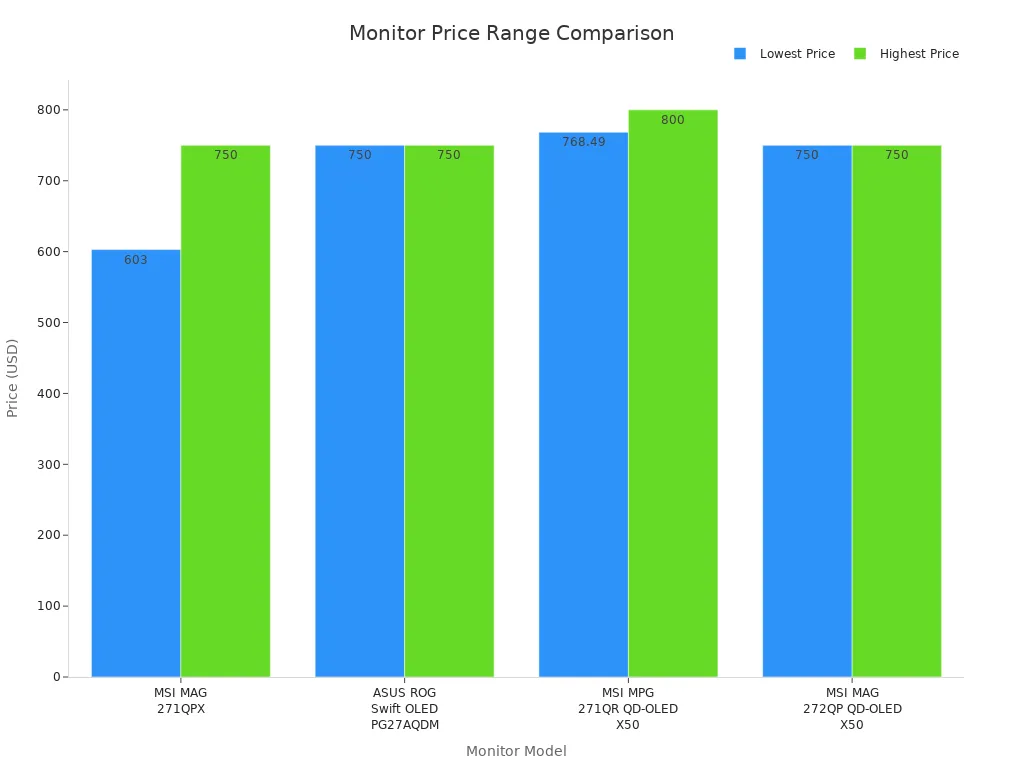
You get a flexible design that fits many setups. The built-in KVM lets you control two computers with one keyboard and mouse. The display supports high brightness and deep blacks, which boost image quality. The oled panel gives you fast response times for gaming and video editing.
Pros:
High refresh rate for esports
Many ports, including USB-C with power delivery
Built-in KVM for easy switching
Competitive price
Cons:
Design may feel basic compared to premium models
Oled panel may need care to avoid burn-in
Best Use Cases:
You get the best results if you play fast games or need a display for work and play. The design also works for electronics projects that need a flexible oled panel.
Price and Value:
You pay less than for some rivals, but you get top oled performance and a smart design.
LG 27GS95QE
The LG 27GS95QE gives you a fast and responsive oled display for gaming and creative work. The 27-inch panel uses oled technology for deep blacks and bright colors. You get a 240Hz refresh rate and a 0.03ms response time. This means you see every detail in fast action. The display supports both NVIDIA G-SYNC and AMD FreeSync, so you avoid screen tearing.
Feature | Specification |
|---|---|
Refresh Rate | 240Hz |
Response Time | 0.03ms |
Display Type | oled |
G-SYNC Support | Yes |
FreeSync Support | Yes |
HDMI Ports | 2 |
DisplayPort | 1 |
USB Ports | 1 x USB 3.0 Type-B Upstream / 2 x USB 3.0 Type-A Downstream |
Dimensions (with stand) | 18.30"-22.60" x 23.80" x 10.20" |
Weight (with stand) | 16.20 lbs |
The design includes height, tilt, rotation, and swivel adjustments. You can mount the display with VESA 100×100 mm. The oled panel gives you high color quality and strong HDR support. The display fits well in gaming setups, creative studios, and home offices.
Feature | Description |
|---|---|
Screen Size | |
Panel Type | oled |
Resolution | QHD (2560 x 1440) |
Refresh Rate | 240 Hz |
Response Time | 0.03 ms (GtG) |
HDR Support | HDR10 |
FreeSync and G-Sync Support | Yes |
Ergonomic Adjustments | Height, tilt, rotation, swivel |
Connectivity | HDMI 2.1, DisplayPort 1.4, USB-A/B, 3.5mm audio |
VESA Mount Compatibility | Yes (100×100 mm) |
Pros:
Ultra-fast response and high refresh rate
Flexible design for many setups
Strong HDR and color quality
Supports both G-SYNC and FreeSync
Cons:
Price may be high for some users
Oled panel may need care to avoid image retention
Best Use Cases:
You get the most from this display if you play fast games or create high-quality content. The design also works for electronics projects that need a flexible oled panel.
Price and Value:
You pay for premium features, but you get top oled quality and a flexible design.
Tip: When you choose a small oled display for your electronics project, check the size, port options, and mounting features. A flexible design helps you fit the display into custom spaces. Look for models with USB-C or HDMI for easy connection.
Head-to-Head OLED Comparison
Image Quality and Performance
When you pick an OLED display, you want great pictures. OLED panels show deep blacks and strong contrast. Each pixel lights up by itself, so you see all the details. Colors look bright and true on the screen. Motion is smooth because of high refresh rates. Many OLED displays can reach 240 Hz or more. This lets you watch fast action without blur. The table below shows how these displays do:
Specification | Value |
|---|---|
Brightness | |
Color Accuracy | 100% sRGB, 99% DCI-P3 |
Color Performance | ∆E < 1 |
Refresh Rate | 240 Hz |
Response Time | 0.1 ms (GTG) |
You will see deep blacks and strong contrast in games and movies. These things help you enjoy the best picture for any use.
Durability and Build
You want your OLED display to last for years. Makers use special parts and smart designs to keep it strong. The display has many layers, like a tough base and a cover for protection. Some displays use flexible parts, so you can use them in different ways. You also get features that protect your OLED panel:
Sleep mode and power-saving settings help the display last longer.
Pixel shifting moves the image to stop burn-in.
Keeping brightness not too high keeps the layers safe.
Cleaning and good care help your display stay bright.
Your display can stay clear and bright for a long time.
Compatibility and Connectivity
You need your display to work with your devices. OLED displays have many ports, like HDMI, DisplayPort, and USB-C. You can connect game consoles, PCs, and laptops. Many displays work with both consoles and PCs. The table below shows what you get:
Feature | Description |
|---|---|
Screen Size | 27-inch OLED screen |
Refresh Rate | |
Gaming Compatibility | Works with consoles and PCs |
Connectivity | HDMI, DisplayPort, USB-C, USB-A |
You can use your OLED display for gaming, work, or projects. The many options make it easy to set up.
Price and Value
You want to get the most for your money. OLED displays have different prices. Some cost more because they are brighter, have better pictures, or more features. Even mid-range models give you strong performance and deep blacks. If you need a display for a project, look for one with a flexible design and the right ports. You can find a display that fits your budget and gives you great quality.
Tip: Always pick the display features that fit your needs. You get the best value when you choose the right OLED display for your setup.
Recommendations for Gaming Monitors and More
Best for Gaming Enthusiasts
If you love gaming, you want a screen that is fast and clear. The right oled display helps you see every move in your games. You get sharp pictures and strong contrast. The table below lists the best gaming monitors:
Model | Size | Resolution | Refresh Rate | Response Time | Target Audience |
|---|---|---|---|---|---|
MSI MPG 271QRX | 27-inch | 1440p | 360Hz | 0.03ms GtG | Overall Value PC |
ASUS ROG Swift OLED PG27UCDM | 27-inch | 4K QD-OLED | 240Hz | 0.03ms | Competitive FPS |
Samsung Odyssey OLED G8 (G80SD) | 31.5-inch | 4K | 240Hz | N/A | Console Gaming |
AOC Q27G4ZD | N/A | N/A | 240Hz | N/A | Budget OLED Entry |
ASUS ROG Strix OLED XG32UCWMG | 32-inch | 4K | 240Hz | N/A | Flexible Large-Screen Pick |
These oled displays give you smooth action and deep blacks. Fast refresh rates and quick response times help you play better. You see bright colors and true blacks, making games and tv fun.
Best for Productivity and Daily Use
If you work a lot, you need a screen that lasts and looks good. The LG UltraGear 32GS95UE-B monitor does not burn in easily, even after many hours. You can use it for work and daily tasks without losing picture quality. New oled displays show sharp text and strong contrast. You enjoy tv shows and movies with bright colors. This makes oled tvs great for both office and home.
Note: Oled displays give you clear images and strong contrast for long work times. Your workspace stays bright and easy to see.
Best Value Option
If you want a good tv for less money, check these oled displays. The table below shows top value picks:
Model | Price Range | User Rating | Key Features |
|---|---|---|---|
LG B5 | N/A | N/A | 4 HDMI 2.1 ports, good dark room performance, struggles in bright light |
Samsung S85F | N/A | 4.8/5 | QD-OLED, vibrant colors, HDR support, full HDMI 2.1 connectivity, VRR support |
Panasonic Z85 | N/A | 4.4/5 | HDMI 2.1 (2 ports), Dolby Vision, HDR10+, good built-in speakers |
Sony Bravia XR8B | N/A | 4.8/5 | 4 HDMI 2.1 ports, Dolby Vision, Google TV, good picture quality |
You get strong contrast and bright colors with these picks. These oled tvs help you find a screen that fits your budget. You can watch tv, play games, and see movies with clear pictures.
Best for Versatile Use
If you want a screen for many things, oled is a good choice. Oled technology gives you perfect black levels. Each pixel turns off for true blacks and high contrast. You see deep images and bright colors. Here are reasons why oled displays work for many uses:
You see bright colors and accurate pictures.
You get many colors without needing a backlight.
You enjoy games, tv, and media with great visuals.
The table below shows features for versatile oled displays:
Feature | Description |
|---|---|
Compact Size | Good for wearable tech, MP3 players, and handheld devices because it is small. |
Low Power Consumption | Saves energy, so it works well for battery devices and wearables. |
High Contrast | Shows sharp pictures even in low light, so you can use it anywhere. |
Self-Luminous Technology | Does not need a backlight, which saves more energy. |
Wide Operating Temperature | Works well in many different places. |
Robust Controller Compatibility | Works with many microcontrollers, so it is easy to use in projects. |
You can wire these screens easily and they use little power. Oled displays work with Arduino and Raspberry Pi. You can connect many devices at once. You get clear pictures and save energy in any place.
Choosing the Right Small OLED Display for Electronics Projects
If you build electronics, pick a screen that fits your project. Check the size and resolution first. Small screens are good for wearable tech and handheld gadgets. Make sure the screen works with your devices. HDMI, USB-C, and simple wires make it easy to connect to microcontrollers. Power use is important. Oled screens use less energy, so they are good for battery projects. Look for high contrast and strong controller support. You get sharp pictures and easy setup. Choose a screen that matches your project for the best results.
You have seen how each oled display stands out for gaming, work, or flexible use. The LG C5 oled tv gives you the best picture quality and value for most users in 2026. You get deep blacks, bright colors, and a tv that fits many needs. When you choose your oled tv, look at the table below to match your needs:
Feature | Why It Matters |
|---|---|
Resolution | Sharper images for your tv |
Size | Fits your tv space |
Brightness | Better tv viewing in any room |
Interface | Easy tv connection to devices |
You can pick the right oled tv for gaming, movies, or electronics projects by checking these features.
How to Choose the Right Small OLED Display for Your Electronics Project
OLED screens offer excellent image quality and low power consumption, adding an intuitive interactive window to your electronic projects – a great way to elevate your build.
Choosing a small OLED display is essentially a trade‑off between "easy to use" and "performance first". To help you think clearly, here is a decision framework.
🗺️ A Flowchart to Clarify Your Thinking
The decision process below will help you quickly lock in your direction.
⚡ 1. Core Advantages – Why OLED Is a High‑Contrast Choice
To make an informed decision, first understand OLED's core characteristics.
Excellent image quality – Each pixel emits its own light, delivering true blacks and near‑infinite contrast, plus vivid colours.
Low power consumption – No backlight means very low power when displaying dark content – ideal for battery‑powered portable projects. A typical 0.96‑inch OLED draws about 20mA when active.
Solid‑state illumination – Simple structure: thinner, lighter, and more shock‑resistant.
True black – When a pixel is off, it emits no light – visually deep.
Environmentally friendly – Eliminates the backlight module, simplifying construction and manufacturing.
📋 2. Selection Checklist – Step‑by‑Step Evaluation
Use this checklist as your purchasing guide to filter out unsuitable products from the start.
① My project application and what matters most?
Application Scenario | Recommended Interface | Key Consideration |
|---|---|---|
Wearable / small status screen | I2C | Prefer 0.96‑inch SSD1306 – low power, saves GPIO. If readability is critical, consider larger size. |
Prototyping / quick concept validation | I2C | For ease of use, software ecosystem, and standard sizes, 0.96‑inch SSD1306 is very beginner‑friendly – many libraries have default support. |
Compact instrument / handheld device | I2C / SPI | I2C is preferred when GPIO is limited; SPI if faster screen updates are needed. |
Desktop / interactive dashboard | SPI | For smoother animations or motion graphics, SPI is preferred (at least support for one). Consider upgrading to colour. |
Arduino project relying on mature ecosystem | I2C / SPI | Typically I2C and SSD1306 driver; for advanced interfaces, U8g2 library. |
Wide colour gamut / high image quality | SPI (or advanced users) | AMOLED offers richer colour. Note driver performance, software support, and cost – ensure interface resources are available. |
② Which interface should I choose (I2C vs. SPI)?
I2C is simpler, saves pins, and is good for beginners and low‑speed applications. SPI is faster and more flexible for high‑performance scenarios like animation.
Feature | I2C | SPI |
|---|---|---|
GPIO pins used | Few (2 wires) | More (typically 4‑5) |
Max refresh speed | Lower (<400 kHz) | Higher (up to several MHz) |
Best for | Text, static graphics, status displays, saving I/O | Animation, high refresh rate, complex graphics |
Software complexity | Simple, wide library support | More complex, but mature libraries simplify |
Multi‑device support | Yes (by different addresses) | Requires extra chip select lines – slightly more complex hardware |
③ Size & resolution – How to choose (0.96 vs. 1.3 vs. others)?
0.96‑inch – Minimalist but high pixel density – text can be small.
1.3‑inch – Same resolution but physically larger display – more comfortable to read.
Larger sizes (e.g., 2.4‑inch) can show colour and richer content.
④ Display colour – Monochrome vs. two‑colour vs. full‑colour
Colour | Pros | Cons | Best for |
|---|---|---|---|
Monochrome (e.g., white/blue) | Simple driver, wide library support, lowest power, affordable | Single colour | Most projects with plain text, icons, sensor data |
Two‑colour (e.g., yellow/blue) | Some visual distinction, same driver | Still limited colour | Indicator dashboards (e.g., normal/warning) |
Full colour | Rich colours, stunning visuals | Higher power, more complex driver, higher cost | When photos or colour blocks are needed (AMOLED) |
⑤ Driver chip – SSD1306 vs. SH1106?
SSD1306 has more mature libraries and community support; SH1106 requires dedicated libraries – check compatibility.
Driver Chip | Key Characteristics | Library & Community |
|---|---|---|
SSD1306 | Mainstream choice – drives 0.96‑inch and some 1.3‑inch screens. Internal framebuffer 128x64 matches resolution; address 0x3C/0x3D. | Default libraries (Adafruit, etc.) widely used – easier troubleshooting. |
SH1106 | Specific choice – common on 1.3‑inch screens. Wider framebuffer (132x64) but only displays middle 128 columns – offset possible. | Using wrong library may cause shift. Use universal libraries like u8g2 to fix. |
⚡ Performance & power comparison
Performance – SSD1306 is easy to code with default libraries. SH1106, with proper library, performs similarly but debugging offsets is more troublesome.
Power – Monochrome OLED ~20mA; colour OLED higher. Actual current depends on lit area, colour, and brightness.
📈 Step 3: Follow 2026 Market Trends & Supplier Strategy
More universal driver libraries – Libraries like U8g2 support almost all mainstream driver chips, hiding low‑level differences.
Development resources – Brands like Waveshare provide detailed manuals, schematics, and sample code – greatly lowering your development barrier.
Cost continues to drop – As flexible OLED technology matures, 0.96‑inch monochrome modules have become very affordable.
Modular evolution – “OLED HAT” or expansion boards with physical components like rotary encoders offer richer interaction possibilities.
Industry trend – Tiny drivers and ready‑made modules are accelerating small‑batch integration; costs in the mid‑to‑low range are now very friendly.
Supplier strategy:
Clarify product form – Do you need a ready‑made module (PCB with headers) or just the bare screen with a ribbon cable? The latter requires excellent soldering and mechanical design.
Look for well‑known brands – e.g., Waveshare – they provide complete documentation.
Use customisation possibilities – Smaller manufacturers or distributors may adjust cable length or solder pad type based on order quantity.
🚀 Advanced Ideas – Make Your Screen Truly “Alive”
Hardware connection is only the first step. To make the screen a truly useful interactive window, try these ideas:
Build a sensor data dashboard – Make it a compact meter displaying temperature, humidity, or environmental data in real time.
Leverage the U8g2 graphics library – This powerful library works with almost all microcontrollers, allowing you to draw lines, rounded shapes, and bitmaps with ease.
Share your open‑source projects – Upload your designs to GitHub, Codeberg, or other communities to help other developers.
💎 Summary
Ask about performance – Does your MCU have enough resources to drive the screen? Are I/O pins and communication speed sufficient?
Ask about environment – Will it be used indoors always on, or outdoors in sunlight? High‑brightness screens are needed for sunlight readability.
Ask about content – Is it sans‑serif charts and text? Animations or static characters?
Ask about budget – Is cost a tight constraint, or are you willing to pay more for colour experience?
Ask about compatibility – Does your chosen driver chip (e.g., SSD1306) have official documentation and a quick‑start library?
I hope this guide helps you choose the right OLED display for your project – accurately and elegantly. Consult several manufacturers and read the fine print in datasheets before deciding.
FAQ
What makes OLED displays better than LED or LCD screens?
You see deeper blacks and brighter colors with OLED displays. Each pixel lights up on its own. This gives you higher contrast and better image quality than LED or LCD screens.
How do I choose the right small OLED display for my electronics project?
You should check the size, resolution, and port options. Make sure the display works with your microcontroller or computer. Look for low power use and easy mounting. A table can help you compare:
Feature | Why It Matters |
|---|---|
Size | Fits your project |
Ports | Easy connection |
Power Use | Saves battery life |
Can OLED displays burn in over time?
Yes, OLED displays can burn in if you leave the same image for too long. You can prevent this by lowering brightness and using screen savers. Many new models have features that reduce burn-in risk.
Are OLED monitors good for gaming?
You get fast response times and smooth motion with OLED monitors. High refresh rates and low input lag help you play better. You also see bright colors and deep blacks in every game.
Do OLED displays use a lot of power?
OLED displays use less power than many other screens. Each pixel only uses energy when it lights up. This helps save battery life, especially in portable devices.
See Also
Evaluating Top Transparent OLED Displays for 2025 Innovations
Key Transparent OLED Developments Influencing Displays in 2025
Essential Transparent OLED Display Trends to Monitor in 2026
