Semi-Display Outdoor LCDs or Full Display LCDs Which Is Best for 2026
Shenzhen TopAdkiosk Display Technology Co., Ltd.
Add.: 2F, Bldg 10, Changfeng Industrial Park, Dongkeng, Fenghuang, Guangming, Shenzhen, China 518132
Mobile/WHATSAPP: 86-138 25769658
Email: marketing@topadkiosk.com topadkiosk@gmail.com
Skype: pghenry1
Wechat: adkioskhenry
English Web.: https://www.topkioskdisplay.com/
http://www.ad-kiosk.com/
https://www.toplcddisplay.com/
http://www.multitouchdigitalsignage.com/
https://www.youtube.com/channel/UCYVYNJHxLVEcQD8fuUxXNTA/videos?view_as=subscriber
https://www.facebook.com/TOPADKIOSKSHENZHEN/?ref=bookmarks
You want the best outdoor LCD for 2026. Your needs help decide which is best. If you want fast setup and a modern look, semidisplay.com outdoor lcd has stylish choices. If you need something strong, pick one that lasts long and handles bad weather. Bright screens and anti-glare features are important for outside use. Studies show bright screens and anti-reflective layers help you see in sunlight. You should also think about how much energy it uses, the price, and if it fits your place. For more information, go to https://www.topkioskdisplay.com/.
Key Takeaways
Pick semi-display outdoor LCDs for a new style, easy setup, and lower price. These work well in places with a roof or cover.
Choose full-display outdoor LCDs if you want strong weather safety and toughness. These are best for open spaces with tough weather.
Look at brightness and anti-glare when picking outdoor displays. Bright screens help you see in sunlight. Anti-glare makes the screen clearer.
Check how hard it is to set up and fix. Semi-display types are simple and cheap to put in. Full-display types need more work and care.
Think about how much it will cost later. Full-display outdoor LCDs cost more at first but last longer. They break less and save money in the long run.
Best Choice for 2026
Market Trends
Outdoor LCD technology is changing fast. Companies want displays to be brighter and last longer. They also want them to use less energy. The table below shows the main changes for 2026:
Aspect | Details |
|---|---|
LED Chip Quality | New LED chips use COB technology for more brightness and even light. |
Adaptive Brightness Control | Displays change brightness to match sunlight. This saves energy and helps you see better. |
Outdoor vs. Indoor Displays | Outdoor displays can reach up to 10,000 nits. This makes images clear in sunlight. |
Energy Efficiency | GaN LEDs use less power, cutting costs by up to 30%. |
Lifespan and Reliability | Premium LEDs can last up to 100,000 hours. You do not need to replace them often. |
Environmental Resistance | IP65/IP67 ratings keep out rain, dust, and heat. |
Failure Rate | Better making means fewer dead pixels and less color fading. |
Both semi-display outdoor LCDs and full-display outdoor LCDs get better from these changes. Full-display outdoor LCDs are usually stronger and last longer. Semi-display outdoor LCDs are easier to upgrade and use less energy.
User Needs
You want a display that fits your needs and budget. You may care about style, strength, or saving money. Here is how people’s choices are changing:
You want enclosures that lower repair costs and keep screens working.
You like displays that block water, dust, and heat.
You want a display that looks nice and fits your space.
You care about price. Many people pick enclosures because they cost less than fancy outdoor displays.
You want something strong. Businesses save money by using good enclosures with their displays.
When you look at semi-display outdoor LCDs and full-display outdoor LCDs, you see big differences:
Tip:
Pick semi-display outdoor LCDs for a modern look, fast setup, and lower price. Choose full-display outdoor LCDs if you need the best weather protection and long life.
You should pick what works best for your place. For example, a semi-display outdoor LCD is good for covered walkways or malls. A full-display outdoor LCD is better for open areas or bus stops where it rains or gets dusty.
Now you know what you need to choose the right display for 2026.
Semi-Display Outdoor LCDs: Features & Benefits
Design & Aesthetics
You want your outdoor area to look modern and inviting. Semi-display outdoor lcds give you a slim and stylish design. These displays blend well with many spaces. You can see this with semidisplay.com outdoor lcd, which leads the market with its clean lines and bright screens. Unlike full-display outdoor lcds, semi-display models focus on looks. You get a display that does not overpower your space. The semi-display frame often uses lightweight materials, so you can mount it in more places. This makes your area look neat and up-to-date.
Installation & Affordability
You do not want a long or costly setup. Semi-display outdoor lcds make installation quick and easy. You can set up a semidisplay.com outdoor lcd with less effort than a full-display outdoor lcd. The semi-display design uses fewer parts and weighs less. This means you save on labor and mounting costs. Many people choose semi-display outdoor lcds because they cost less than full-display outdoor lcds. You get a reliable display without spending too much. The semi-display option lets you upgrade or move your display when you need to. This flexibility helps you keep your costs low.
Tip:
If you want to save money and time, pick a semi-display. You will find that semidisplay.com outdoor lcd gives you both value and style.
Applications
You can use semi-display outdoor lcds in many places. These displays work best where you want a balance of looks, cost, and easy setup. Here are some common uses:
Child care facilities
Stores and outdoor markets
Restaurants and cafes
Highway and road signs
A semidisplay.com outdoor lcd fits well in these spots. You get a display that stands out but does not need heavy protection like a full-display outdoor lcd. The semi-display works best in covered or less harsh outdoor areas. You get the benefits of outdoor use without the extra cost of full weatherproofing.
Full-Display Outdoor LCDs: Features & Benefits
Weather Resistance
You want a display that can handle tough weather. Full-display outdoor LCDs give the best waterproofing and protection. These displays have strong cases that block water, dust, and wind. You can use them in rain, snow, or hot sun. The table below shows how full-display outdoor LCDs and semi-display models are different:
Feature | Semi-Display Outdoor LCDs | Full-Display Outdoor LCDs |
|---|---|---|
Casing | Slim, lightweight frame | Heavy-duty waterproof casing |
IP Rating | Moderate (e.g., IP54) | High-level (e.g., IP65/IP66) |
Sunlight Protection | Anti-glare coating | Anti-glare + direct sunlight readable |
Installation Location | Semi-covered areas | Fully exposed outdoor environments |
Full-display outdoor LCDs are best for places with lots of rain or dust. You can put them outside, and they will keep working in storms.
Durability & Reliability
Full-display outdoor LCDs are very strong and last a long time. You can trust them to work for years, even if the weather changes a lot. These displays can handle heat, cold, and bumps. The table below explains how reliable they are:
Metric | Description |
|---|---|
MTBF | Average time between failures for repairable systems. |
MTTF | Average time until failure for non-repairable systems. |
MTTR | Average time to repair a failed system. |
These displays resist fast temperature changes, shaking, sunlight, and static electricity. Full-display outdoor LCDs use tough glass to stop damage from hits or people trying to break them. This means you do not need to fix them often, so you save money.
Note: Very wet or hot weather can still hurt any display. Full-display outdoor LCDs use special seals and coatings to stop rust and keep the inside safe.
Applications
You see full-display outdoor LCDs in many busy or public places. These displays are great where you need the best weather protection and strength. Here are some main benefits:
They block rain, dust, and sunlight
They are bright, so you can see them in the sun
You can read them from many angles
They do not break easily in busy places
They have sensors to change brightness and save power
You can control them from far away
You can put them up in many outdoor spots
They use less energy, so you pay less to run them
You find full-display outdoor LCDs at bus stops, stadiums, factories, and city centers. They work in places where semi-display outdoor LCDs are not strong enough. If you want a display that lasts long and is very tough, full-display outdoor LCDs are the best pick.
High-Brightness & Anti-Glare Technology
Sunlight Performance
You want your outdoor display to stay clear in bright sun. Both semi-display outdoor LCDs and full-display outdoor LCDs depend on high brightness and glare control. A high-brightness screen helps a lot outside. For shaded areas, you need at least 2,000 nits. In direct sunlight, you need 4,000 to 5,000 nits or more for the best picture. The table below shows what brightness you need for each place:
Environment | Notes | |
|---|---|---|
Indoor (reference) | 300-500 nits | Standard commercial |
Window-facing (indoor) | 1,500-2,500 nits | Competing with daylight |
Outdoor (shaded) | 2,000-3,000 nits | No direct sun |
Outdoor (partial sun) | 3,000-4,000 nits | Morning/evening sun exposure |
Outdoor (full sun) | 4,000-5,000+ nits | Direct sunlight all day |
Direct sunlight (noon) | 5,000-7,000 nits | Maximum visibility |
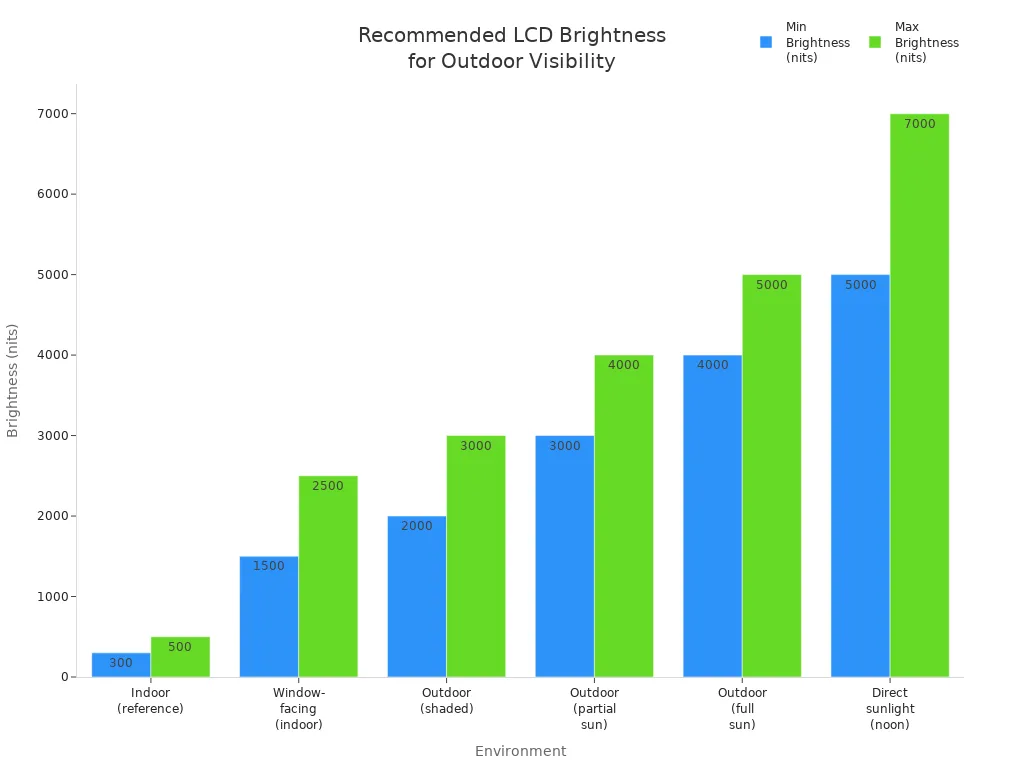
Full-display outdoor LCDs can reach higher brightness and work best in full sun. Semi-display outdoor LCDs are good in shaded or covered spots but may not show clear images in direct sunlight. Both types now have automatic brightness adjustment. This saves energy and keeps the screen easy to read all day.
Anti-glare technology also helps. You do not want reflections that make the screen hard to see. Anti-glare coatings cut down light scatter and make things clearer. This lets you read important information, even when the sun is bright. People in farming and transportation use these features for all-day work.
Tip:
Pick a display with high brightness and anti-glare coating for the best outdoor use.
LCD Types: TN, IPS, VA
The LCD panel type changes how the screen looks outside. There are three main types: TN, IPS, and VA. Each type has good and bad points for outdoor use.
LCD Type | Viewing Angles | Image Quality | Outdoor Suitability |
|---|---|---|---|
TN | Narrow | Poor | Not suitable |
IPS | Wide | Excellent | Suitable |
VA | Moderate | Good | Moderately suitable |
TN panels cost less but have poor image quality and narrow viewing angles. Colors may look different from the side. IPS panels give the best image quality and wide viewing angles. You can see the screen clearly from almost any direction. This is important for outdoor displays. VA panels have good image quality and moderate viewing angles. They work for some outdoor uses but are not as good as IPS.
When you compare semi-display outdoor LCDs and full-display outdoor LCDs, you often see IPS panels in both. Full-display models may use better IPS panels for the best outdoor performance and image quality. Semi-display models may use VA panels to save money and still look good.
Note: For the best outdoor experience, choose an IPS panel with high brightness and anti-glare features.
Installation & Maintenance
Setup Complexity
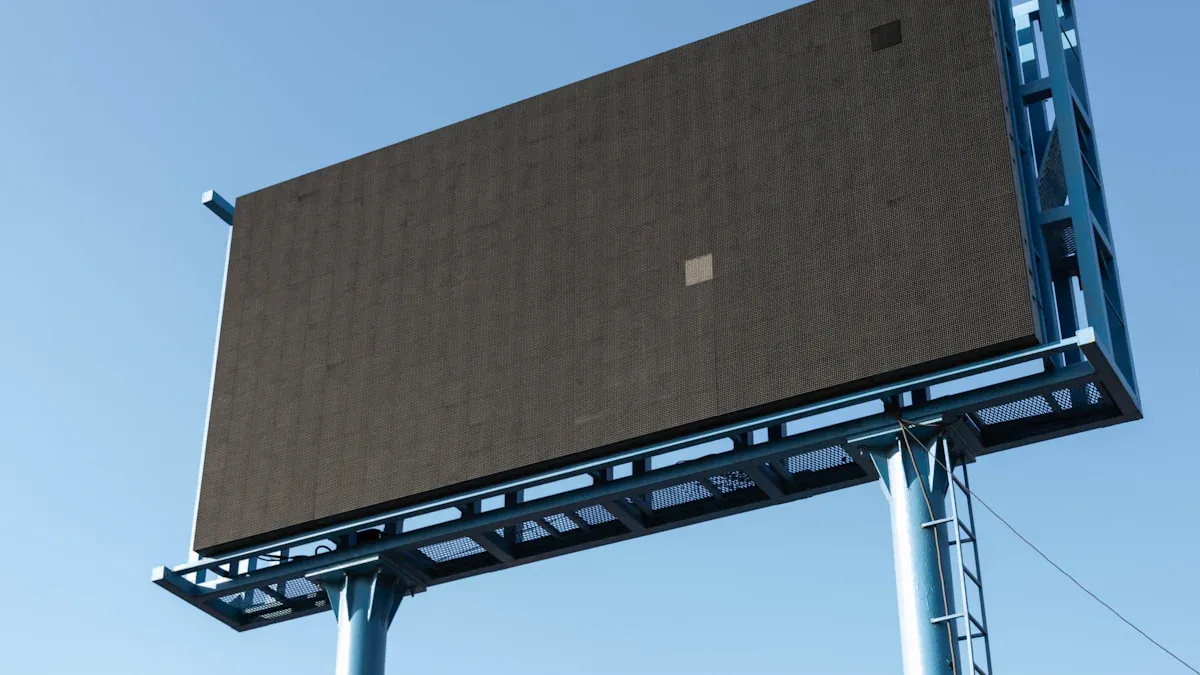
You want to know if setting up your outdoor LCD is easy. Semi-display outdoor LCDs are simple to install. They use lighter frames and fewer parts. This makes them faster to put up. You do not need much help or time. You also save money on labor. Full-display outdoor LCDs are harder to set up. They have heavy cases that need strong support. You must check if they can handle strong winds. The mounting brackets must stay steady in open places.
Here is a table that shows what can make installation hard for each type:
Challenge | Semi-Display Outdoor LCDs | Full-Display Outdoor LCDs |
|---|---|---|
Structural Reliability | Easy to mount in covered spaces | Needs strong support in open areas |
Environmental Factors | Handles mild weather | Built for extreme weather |
Weather Resistance | Moderate sealing | High-level sealing (IP65/IP66) |
Temperature Sensitivity | Works best in mild climates | Handles hot and cold extremes |
Pick the type that fits where you will use it. Semi-display outdoor LCDs are good for malls or covered walkways. They are quick to set up. Full-display outdoor LCDs protect better but need more planning.
Maintenance Needs
You want your display to work well for a long time. Both types need regular care, but not the same amount. Semi-display outdoor LCDs need cleaning and checks every month. Look for cracks or loose parts. Use gentle cleaners to keep the screen clear. Full-display outdoor LCDs need more checks. You must look at water seals, wires, and lightning safety. Check the brackets and grounding often.
Here are some important steps for both types:
Clean the screen with safe cleaners.
Check for damage every month.
Watch brightness and color.
Keep it safe from bad weather and make sure air flows well.
Use surge protectors and good power.
Get a pro to check it once a year.
Remember, how much you spend on care changes the total cost. Full-display outdoor LCDs last longer and work better in tough weather. Semi-display outdoor LCDs cost less to care for but need more checks if the weather is bad. Pick the display that matches your weather and how you will use it. This helps you save money and get the best results.
Cost Analysis
Initial Investment
You want to know how much you will spend at the start. Semi-display outdoor LCDs usually have a lower cost. You pay less for the screen and the frame. The setup is simple, so you save money on labor. Full-display outdoor LCDs cost more. You pay for a strong case, better weather protection, and higher brightness. The table below shows a quick comparison:
Feature | Semi-Display Outdoor LCDs | Full-Display Outdoor LCDs |
|---|---|---|
Purchase Price | Lower | Higher |
Installation Cost | Lower | Higher |
Frame and Casing | Slim, light | Heavy, weatherproof |
Brightness | Good for shade | Best for sunlight |
You should think about your location and needs. If you want a display for a covered area, a semi-display outdoor LCD will save you money. If you need a screen for a busy street or open space, you may need to spend more for a full-display outdoor LCD.
Long-Term Value
You want your display to last and work well for years. Full-display outdoor LCDs often have a longer lifespan. They resist rain, dust, and heat better. This means you will not need to replace them as often. Semi-display outdoor LCDs may need more repairs if you use them in harsh weather.
You should also look at warranty and support. Some models, like the Samsung OM24E, offer a 2-year warranty. This gives you peace of mind. You can use these displays 24/7, and they have features like 1500 Nit brightness for outdoor use.
Here are some things to think about for long-term value:
How often you need repairs
How long the display works before you need a new one
The support and warranty you get from the maker
The energy use and how much you pay for power
You should compare cost and performance before you buy. A higher cost at the start may save you money later if the display lasts longer and needs fewer repairs. If you want the best value, match the display to your weather and how you will use it.
Use Cases & Recommendations
Semi-Display Outdoor LCDs: Best Scenarios
You want a display that fits your space. Semi-display outdoor lcds are good for places where style matters and setup is easy. You see them at mall entrances, walkways, and outdoor cafes. Semi-display outdoor lcds look modern and match many buildings. You can install them fast because they are light. This makes them smart for areas without harsh weather.
You get the most from semi-display outdoor lcds in these cases:
You want to change your display often.
You need to move your display sometimes.
You care about how your space looks.
You want to spend less on setup and care.
You use your display in shaded or covered spots.
Semi-display outdoor lcds show moving content and let you interact with touch. You can use touch for menus or schedules in stores or schools. These displays work well for signs and promotions. They last a long time if you use them in the right place. Semi-display outdoor lcds help you save money and still give bright screens and touch features.
Tip:
Pick semi-display outdoor lcds if you want easy upgrades, style, and flexibility in places with mild weather.
Full-Display Outdoor LCDs: Best Scenarios
Full-display outdoor lcds protect best and last longer. You should use them in open spaces, busy streets, or places with lots of rain or sun. Full-display outdoor lcds have strong cases and high IP ratings. They keep working in storms or heat. You see them at bus stops, stadiums, and city centers.
Here is a table that shows where full-display outdoor lcds are best:
Industry/Environment | Benefits |
|---|---|
Retail and Digital Signage | Gets attention from all sides, showing bright and engaging ads. |
Automotive and Transportation | Gives clear info to many people, helping with infotainment. |
Gaming and Entertainment | Shows great visuals with little color change, so many can enjoy. |
Full-display outdoor lcds last longer in tough weather. You get fewer repairs and a longer life. These displays show moving content and work well in bright sunlight. You can use them for public info, ads, and safety alerts. Full-display outdoor lcds also let you interact with touch, which helps with maps and tickets.
Note:
Choose full-display outdoor lcds if you need strong protection, weather resistance, and long-lasting value in open outdoor places.
Future-Proofing for 2026
You want your display to last for years. To make your outdoor display ready for 2026, look for these features:
AI-powered personalization lets you show content that fits your audience.
5G connectivity gives fast updates and easy cloud control.
Energy-saving displays help you use less power and protect nature.
Augmented reality and interactive signs let users try new ways to interact.
Voice-activated displays make your content easier to use and more fun.
Semi-display outdoor lcds and full-display outdoor lcds both have these features. Pick the type that fits your needs and location. Semi-display outdoor lcds are easy to upgrade and cost less. Full-display outdoor lcds protect best and last longer. Both types now let you touch and interact, so you can keep up with new trends.
Tip:
For the best results in 2026, pick displays with AI, 5G, and interactive features. Make sure your display fits your space and can handle new technology.
You now know the main ways semi-display outdoor LCDs and full-display outdoor LCDs are different. Here is a table that makes it easy to compare them:
Feature | Semi-Display Outdoor LCDs | Full-Display Outdoor LCDs |
|---|---|---|
Casing | Slim, lightweight frame | Heavy-duty waterproof casing |
IP Rating | Moderate (e.g., IP54) | High-level (e.g., IP65/IP66) |
Sunlight Protection | Anti-glare coating | Anti-glare + direct sunlight |
Cooling System | Light fans or airflow | Industrial fans + thermal sensor |
Average Lifespan | 3–5 years | 5–8 years |
Use semi-display outdoor LCDs in shopping centers, parking lots, or tourist places with some cover.
Use full-display outdoor LCDs for billboards by the road, sports stadiums, or tough work areas.
Think about where you want to put your display. Check the weather and how much money you can spend. Pick the display that works best for you in 2026.
Outdoor LCD Showdown: Semi-Outdoor vs. Full-Outdoor Displays
Choosing between semi-outdoor and full-outdoor digital signage is the first critical decision for any outdoor project. Pick wrong, and your screen might be unreadable in daylight – or destroyed by the first heavy rain.
The core of the decision comes down to one question: Does your screen need to survive direct sunlight and driving rain, or only indirect light and occasional splashes?
🆚 Semi-Outdoor vs. Full-Outdoor: Key Differences at a Glance
Feature | Semi-Outdoor Display | Full-Outdoor Display |
|---|---|---|
Core Philosophy | Balance cost and performance for moderate environmental challenges | Maximum protection and durability for extreme conditions |
Typical Scenarios | Street-facing shop windows, covered bus stops, mall entrances, sheltered parking garages | Uncovered billboards, stadiums, standalone kiosks, open plazas with no shelter |
Brightness | Approx. 500 – 2,500 nits – enough for diffused or indirect sunlight | 2,500 – 10,000+ nits – remains clearly readable under direct midday sun |
Ingress Protection (IP) Rating | IP54 or IP65 – dust‑protected, splash‑resistant or light rain‑resistant | IP65 minimum, often IP66 or higher – fully dust‑tight, withstands powerful water jets, heavy rain, even brief immersion |
Design & Structure | Slim, sleek, easy to install – blends well with architecture | Heavy, rugged, bulky weatherproof housing – impact‑resistant and vandal‑resistant |
Cooling Technology | Natural ventilation or light auxiliary fans | Industrial‑grade fans, smart temperature control, air conditioning, even heating modules for freezing climates |
Advantages | ✅ More affordable | ✅ Reliable in any weather |
Disadvantages | ❌ Cannot withstand prolonged heavy rain or direct sunlight | ❌ High upfront purchase & installation cost |
Estimated Cost | ~43" models: from hundreds to a few thousand USD | 55" full‑outdoor units start at $5,000 – $6,000 USD; higher‑spec models can reach tens of thousands |
What do IP ratings mean?
IP = Ingress Protection. First digit (5 or 6) = dust protection (6 = totally dust‑tight). Second digit (4,5,6) = water protection – higher is better. IP54 = splash‑proof; IP65 = protected against low‑pressure water jets; IP66 = withstands powerful water jets.
⚙️ What Exactly Are "Semi-Outdoor" and "Full-Outdoor"?
Semi-Outdoor – Not simply “half outside”. It means the screen is physically sheltered from direct sun and rain. Examples: behind a shop window (viewed from outside), under a bus stop canopy, or inside a covered walkway. The main challenges are bright ambient light and occasional splashes.
Full-Outdoor – The screen is completely exposed to nature. It must endure direct sunlight, heavy rain, dust, extreme temperatures, and potential physical impact, 24/7.
✅ A Simple 3‑Step Decision Framework
Step 1: Evaluate Your Physical Environment
Ask yourself these questions:
Question | Answer → Implication |
|---|---|
Is there a roof or canopy overhead? | Yes → consider semi‑outdoor / No → consider full‑outdoor |
Will direct sunlight hit the screen? | No / Rarely → consider semi‑outdoor / Yes → full‑outdoor |
Will it get rained on directly? | Yes → must be full‑outdoor / No / Occasional splash → consider semi‑outdoor |
What is the local climate? | Mild → semi‑outdoor may suffice / Heavy rain, snow, typhoons → must be full‑outdoor |
Step 2: Match Minimum Technical Specs
Scenario | Recommended Minimum Brightness | Recommended Minimum IP Rating | Key Cooling / Protection |
|---|---|---|---|
Semi-Outdoor | 1500 nits | IP54 | Anti‑glare (AG) coating |
Full-Outdoor | 3000 nits | IP65 | Industrial fans, temperature control |
Step 3: Match to Your Real‑World Use Case
“I need to play ads behind a street‑facing glass window.”
This is a classic semi‑outdoor use case. Choose a 1500–2500 nits model with anti‑glare coating.“I run a 24‑hour restaurant with an open plaza outside.”
Fully exposed → you need IP65 or higher, brightness 3000+ nits, and a weatherproof outdoor enclosure.“My budget is tight, but the screen must go outdoors. Any shortcuts?”
This is risky. Using a semi‑outdoor screen in a full‑outdoor environment will likely lead to early failure from water ingress or overheating. If budget is very tight, start with a genuinely sheltered semi‑outdoor location (e.g., under an awning).
💎 The Bottom Line
In short:
Sheltered, no direct sun, budget‑conscious → Semi‑outdoor
No shelter, direct sun, need durability → Full‑outdoor
The decision always begins with your screen’s real physical environment.
Would you like to share the exact location where you plan to install the screen? (e.g., a covered bus stop, an open commercial street, a shop window, etc.) I can help you make a more specific recommendation.
FAQ
What is the main difference between semi-display and full-display outdoor LCDs?
You see the biggest difference in weather protection. Semi-display outdoor LCDs work best in covered or mild areas. Full-display outdoor LCDs handle rain, dust, and sun in open spaces. You choose based on your location and weather needs.
Which type lasts longer outdoors?
Full-display outdoor LCDs last longer. They use strong cases and seals to block water and dust. Semi-display outdoor LCDs may need more repairs if you use them in harsh weather. You get more years from full-display models in tough conditions.
Are semi-display outdoor LCDs easier to install?
Yes, you can install semi-display outdoor LCDs faster. They use lighter frames and fewer parts. You save time and money on setup. Full-display outdoor LCDs need strong support and careful planning because they are heavier and more complex.
Which display is better for bright sunlight?
Full-display outdoor LCDs work better in direct sunlight. They reach higher brightness and use advanced anti-glare coatings. Semi-display outdoor LCDs look good in shaded or covered spots but may not stay clear in full sun.
How do costs compare between the two types?
Tip:
You pay less for semi-display outdoor LCDs at first. Full-display outdoor LCDs cost more but save money over time with fewer repairs and longer life. Choose based on your budget and how tough your outdoor space is.
See Also
Top LCD Kiosks For Retail Spaces To Consider In 2026
Highly Rated Outdoor LCD Kiosks To Explore In 2026
Selecting The Ideal LCD Round Display For Your 2025 Project
Leading Providers Of Outdoor LCD Display Kiosks Available
Best LCD Screen Manufacturers And Brands For Upcoming Projects
