OLED display module guide to features and prices
You want the best OLED display module for your needs in 2026. Picking the right one is important. Smartphones make up 37.6% of the market. OLED gives you great features for gaming. Gaming monitors get higher refresh rates with OLED. They also show better images. When you compare modules, check display quality. Look at size options and price too. The right choice gives you a clear view. It also fits your budget.
Shenzhen TopAdkiosk Display Technology Co., Ltd.
Add.: 2F, Bldg 10, Changfeng Industrial Park, Dongkeng, Fenghuang, Guangming, Shenzhen, China 518132
Mobile/WHATSAPP: 86-138 25769658
Email: marketing@topadkiosk.com topadkiosk@gmail.com
Skype: pghenry1
Wechat: adkioskhenry
English Web.: https://www.topkioskdisplay.com/
http://www.ad-kiosk.com/
https://www.toplcddisplay.com/
http://www.multitouchdigitalsignage.com/
https://www.youtube.com/channel/UCYVYNJHxLVEcQD8fuUxXNTA/videos?view_as=subscriber
https://www.facebook.com/TOPADKIOSKSHENZHEN/?ref=bookmarks
As long as we have the blueprints, Shenzhen TopAdkiosk Display Technology Co., Ltd no worse than anyone else.
please contact Shenzhen TopAdkiosk Display Technology Co.
Application | Estimated Market Share in 2025 | Key Insights |
|---|---|---|
Below 6 Inches Panels | 37.6% | Smartphones sell the most, and OLED is great for gaming. |
Smartphones and Tablets | 24.3% | OLED makes devices look better and adds value. |
Gaming Monitors | N/A | OLED gives faster refresh rates and better visuals for gamers. |
Key Takeaways
OLED displays show great picture quality. They have real blacks and bright colors. This makes them good for gaming and watching videos.
Tandem OLED technology makes screens brighter and last longer. It uses less power. This gives you a better way to watch things.
AMOLED screens change pixels faster. This helps stop blur in fast games. It also makes pictures look better.
When picking an OLED display, think about brightness, size, and price. These help you choose what works best for you.
Mid-range OLED modules give the best value. They balance good performance and cost for most people.
OLED display module features
OLED display modules are special because they show very clear pictures. They react fast and do not use much energy. You can find these modules in smartphones, gaming monitors, and wearables. The technology uses organic materials that light up with electricity. This makes the screen show true black, bright colors, and strong contrast. OLED screens are thin and can bend. You can see the screen from many angles and the picture stays sharp. These things make OLED display modules popular for people who want great screens.
Display quality and brightness
You want a screen that is bright and easy to see everywhere. OLED display modules use new technology to make screens brighter and better. Dual-stack, or tandem OLED, puts two layers of organic material together. This helps the screen get brighter and last longer. Some models can reach up to 7,000 nits of brightness. For example, the AQUOS R10 smartphone from Sharp gets 3,000 nits. Tianma’s stacked layer OLED device reaches 7,000 nits.
Manufacturer | Product | Peak Brightness (nits) |
|---|---|---|
Sharp Corporation | AQUOS R10 smartphone | 3,000 |
Tianma | Stacked Layer OLED Device | 7,000 |
Tandem OLED also saves power and helps the screen last longer. The table below shows the main things that make OLED display quality and brightness good in 2026.
Specification | Description |
|---|---|
Brightness Levels | Tandem OLED technology lets screens get brighter than normal OLED. |
Efficiency | Tandem OLED uses less power for the same brightness. |
Lifetime | Tandem OLED lasts longer, so you can use it for years. |
Architectural Design | The stacked design of Tandem OLED makes screens work better. |
You get a screen that looks good in bright rooms and outside. This makes OLED display modules a smart pick for gaming and mobile devices.
Color accuracy and refresh rate
Color accuracy is important if you want real-looking pictures and smooth games. OLED display modules show bright colors, deep blacks, and strong contrast. You can see every detail, from light spots to dark shadows. Gamers like OLED because it makes games look real and exciting. The perfect blacks and high contrast make effects stand out. This is great for HDR gaming.
Feature | OLED Displays |
|---|---|
Color Accuracy | Bright colors and deep blacks |
Refresh Rate | High refresh rates help with gaming |
Visual Experience | Clear and exciting visuals |
Concerns | Burn-in and lower brightness in sunlight |
OLED screens change pixels very fast, usually in 0.1 to 0.3 milliseconds. This means you see almost no blur, even in fast games at 240 Hz or 360 Hz. The high refresh rate and quick pixel changes make action smooth and clear. You can look at the screen from the side and still see a sharp picture.
Pixels change very fast (0.1–0.3 ms)
Almost no blur in fast games (240 Hz or 360 Hz)
Perfect blacks and strong contrast for bright images
Power use and durability
Power use matters if you want your screen to last all day. OLED display modules use less power than LCDs, especially with dark mode or dark pictures. The chart below shows how much power OLED and LCD use in different cases.
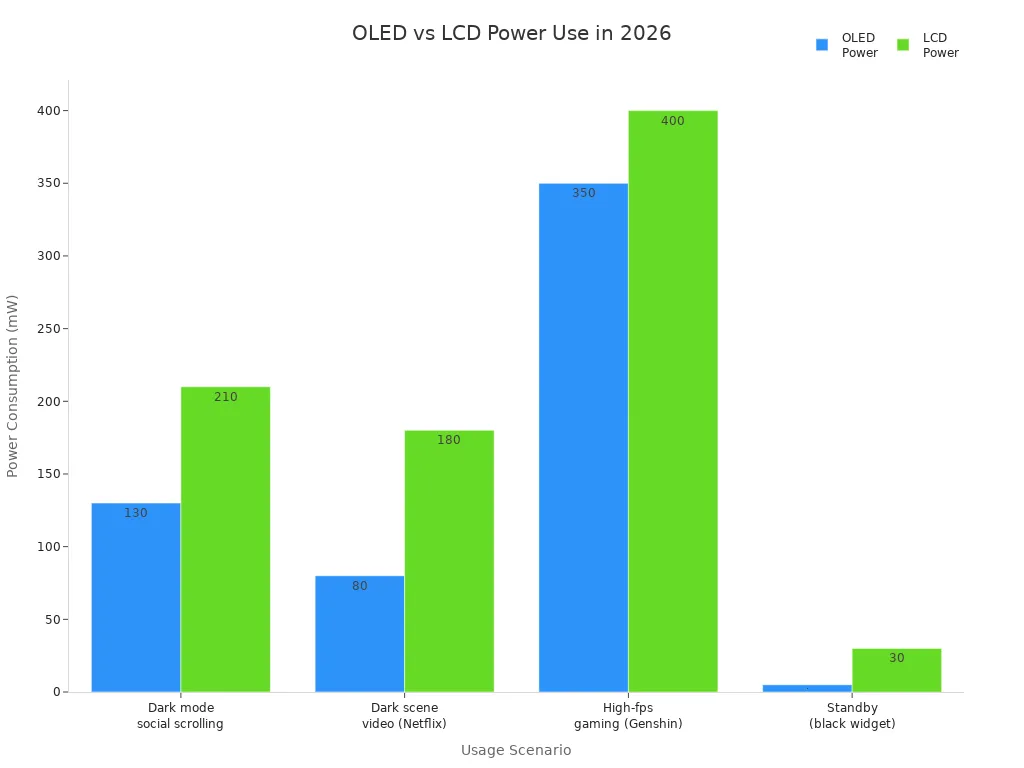
Usage Scenario | OLED Power (mW) | LCD Power (mW) | Power Savings (%) |
|---|---|---|---|
Dark mode social scrolling | 130 | 210 | 40 |
Dark scene video (Netflix) | 80 | 180 | 55 |
High-fps gaming (Genshin) | 350 | 400 | 12.5 |
Standby (black widget) | 5 | 30 | 83 |
You save battery, especially with dark themes or dark videos. OLED display modules are also strong and last a long time. Good OLED displays keep 80% of their brightness for about 10,000 to 15,000 hours. If you use your screen eight hours a day, it can last 65,000 to 85,000 hours, or 19 to 24 years. Using high brightness or showing the same picture all the time can make it last less, but moving pictures help it last longer.
Usage Scenario | Lifespan (Hours) | Lifespan (Years) |
|---|---|---|
Average use (8hrs/day) | 65,000 - 85,000 | 19 - 24 |
100% brightness | 50,000 - 59,000 | 14 - 16 |
Static image (12hrs/day) | 15,000 | 1 - 2 |
Dynamic content (e.g., Netflix) | 89,000 | 25 - 30 |
Industrial OLED panels are made to work hard and can last 30,000 to 100,000 hours before getting half as bright. Things like heat, brightness, and what you show on the screen can change how long it lasts.
AMOLED vs OLED display
You might wonder what makes AMOLED different from OLED. AMOLED means Active Matrix Organic Light Emitting Diode. This technology uses a thin film transistor to control each pixel. In 2026, AMOLED is better at saving power, comes in bigger sizes, and is made better. You see AMOLED in laptops, car screens, and more, not just in phones and TVs.
Feature | AMOLED in 2026 | Traditional OLED |
|---|---|---|
Efficiency | Made with better processes | Not as focused on saving power |
Scalability | Bigger sizes and more made at once | Harder to make big screens |
Power Efficiency | Uses less power | Used to use more power |
Color and Performance | Better color and works better | Normal performance |
Application Range | Used in laptops, cars, and more | Mostly in phones and TVs |
AMOLED display modules give you better color, use less power, and come in bigger sizes. Dual-stack OLED, or tandem OLED, makes screens even brighter and last twice as long as single-stack OLED. You get up to 40% less power use and more brightness at the same power.
Feature | Dual-Stack OLED (Tandem) | Single-Stack OLED |
|---|---|---|
Brightness | Brighter at same power | Normal brightness |
Longevity | Lasts twice as long | Normal lifespan |
Power Consumption | Up to 40% less | Uses more power |
Current Density | Lower | Higher |
You can count on AMOLED to give you great color, save power, and last a long time for all your needs.
OLED display module sizes

Small modules for wearables
You see small oled display module options in wearables like smartwatches and fitness trackers. These modules use flexible technology, which lets you wear them comfortably. The most common sizes in 2026 include 1.39-inch, 1.5-inch, and 1.8-inch displays. You get round or rectangular shapes, which fit different devices.
Size (inches) | Type of Display |
|---|---|
1.39 | Round/Circular OLED Flexible |
1.5 | Flexible OLED |
1.8 | Flexible PMOLED |
You benefit from thin screens and low power use. Smartwatches use oled for always-on displays. Fitness trackers show clear numbers and graphics. Handheld gadgets use these modules for bright, sharp images. A compact 0.96-inch screen gives you 128×64 pixels. It works with 3V to 5V, so you can use it in many devices. This helps you save battery and see information clearly.
Medium modules for smartphones
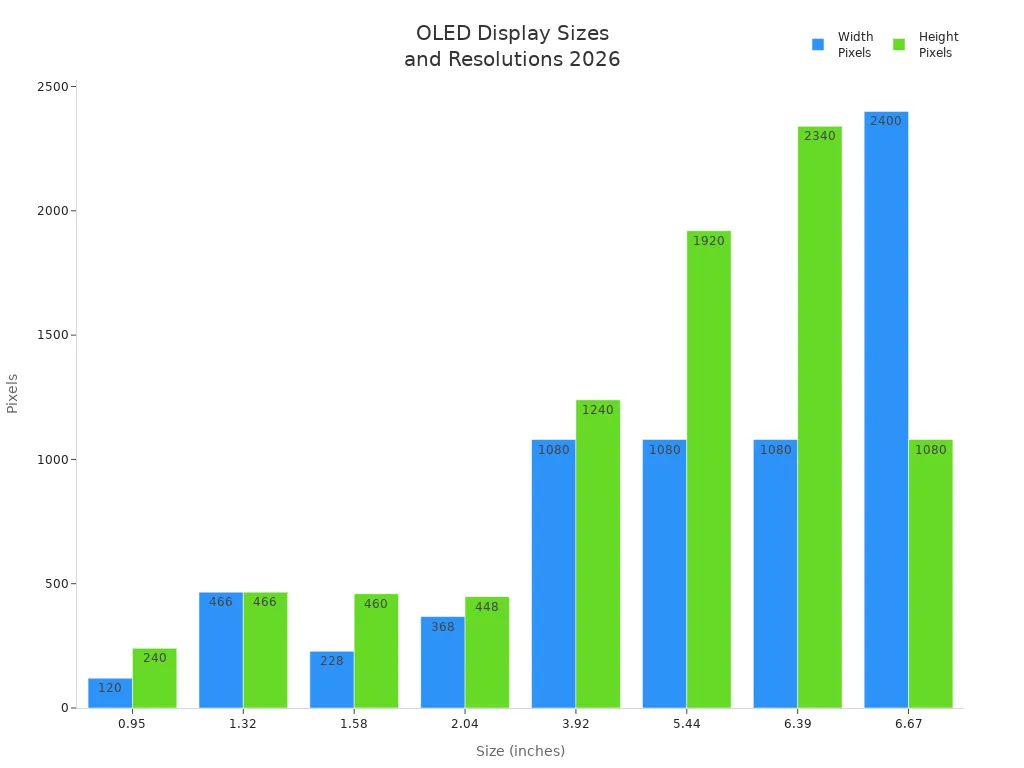
Medium-sized oled modules power most smartphones. You get bright colors, high contrast, and smooth refresh rates. These displays range from 3.92 inches to 6.67 inches. You see sharp images and pure blacks, which make videos and games look real.
Size (inches) | Resolution (pixels) |
|---|---|
6.39 | 1080×2340 |
3.92 | 1080×1240 |
5.44 | 1080×1920 |
6.67 | 2400×1080 |
0.95 | 120×240 |
1.58 | 228×460 |
1.32 | 466×466 |
2.04 | 368×448 |
You enjoy better color, longer battery life, and new shapes like curved or foldable screens. AMOLED gives you top performance and flexibility.
Large modules for monitors
Large oled modules lead the market for monitors and TVs. You find popular sizes from 27 inches up to 77 inches. A 27-inch amoled monitor gives you enough space for multitasking. You can open many windows and still see everything clearly. For gaming, this size offers high refresh rates and sharp visuals. You avoid scaling problems that happen with smaller 4K screens. Bigger displays, like 55 or 77 inches, give you a cinema-like experience at home.
Use cases by size
Wearables: Track your health and time with small, bright screens.
Smartphones: Enjoy vivid color, deep contrast, and smooth motion with medium amoled displays.
Monitors: Work and play better with large amoled screens that show every detail.
TVs: Watch movies with pure blacks, high brightness, and wide viewing angles.
You choose the right oled display module size based on your needs. Each size gives you the best brightness, color, and contrast for its use. AMOLED display modules help you see more, do more, and enjoy every pixel.
OLED display module price trends
In 2026, oled display module prices change a lot. You can find many choices for every budget. AMOLED screens are now in phones, monitors, and wearables. Prices dropped because factories make more panels. New technology also helps lower the cost. You get better brightness, color, and contrast for less money. Let’s see how price and features compare for budget, mid-range, and premium oled modules.
Budget OLED modules
You want a good screen but not spend too much. Budget oled modules give you basic features for less money. These displays are good for simple tasks. You see them in cheap smartphones, small monitors, and wearables. The price starts at about $899. You get okay brightness and color, but not the best contrast or fastest pixels. Some budget oleds do not have HDMI 2.1. They also have less burn-in protection. You may see colors that are not as sharp. Viewing angles might not be as good. These screens still show better blacks and are thinner than LCDs.
Lower price, starting at $899
Good for basic use and simple devices
Limited contrast and color accuracy
Slower pixel response and less burn-in protection
Mid-range OLED modules
You want more features and better performance. Mid-range oled modules give you a good mix of price and quality. These displays cost between $1,199 and $1,499. You get lots of features like high brightness, strong contrast, and fast pixel response. Mid-range amoled screens are great for gaming, streaming, and daily use. You see smooth refresh rates and wide viewing angles. Most people pick these modules because they are a good deal.
Display Type | Price Range | Features |
|---|---|---|
Entry-tier OLED | ~$899 | Lacks HDMI 2.1, limited burn-in protection |
Mid-tier OLED | $1,199–$1,499 | Full feature set |
Flagship OLED | >$1,800 | Extra screen real estate, few extra features |
Affordable cost for most users
High brightness and color accuracy
Fast pixel response for gaming
Wide viewing angles and good contrast
AMOLED displays are getting cheaper as tech gets better. This means you can buy better screens for less money.
Premium OLED modules
You want the best screen with all the top features. Premium oled modules cost more than $1,800. These displays give you perfect blacks and almost endless contrast. You also get the best color accuracy. The designs are very thin and can bend. Pixel response is super fast. Premium amoled screens are used for high-end gaming monitors, top smartphones, and fancy TVs. You get the brightest screens, the widest viewing angles, and the smoothest refresh rates.
Feature | Premium OLED Displays | Budget/Mid-Range Displays |
|---|---|---|
Contrast Ratio | Perfect black levels, infinite | Limited contrast capabilities |
Color Accuracy | Superior color, wide viewing angles | Moderate color accuracy |
Response Time | Extremely fast pixel response | Slower response times |
Design Flexibility | Lightweight, ultra-thin, bendable | Bulkier designs |
Highest price, over $1,800
Best brightness, color, and contrast
Ultra-fast pixel response and smooth refresh
Flexible and lightweight designs
You pay more for these features, but you get the best screen and viewing experience.
Value and price comparison
You want to know if paying more gives you better value. In 2026, oled display module prices match the features you get. Budget modules are good for simple needs. Mid-range amoled displays give you the best mix of price and performance. Premium modules have the best brightness, color, and contrast, but cost a lot more.
Tip: Pick a mid-range amoled display if you want the best value for most things. You get high brightness, fast pixel response, and strong contrast without paying the most.
Gaming monitor prices are very different. Some are cheap, but premium ones can cost a lot. Smartphone oled prices are now close to LCDs. You get better color and brightness for the same price. The market gives you more choices, so you can pick what you need.
Budget: Good for basic use, lower price, fewer features
Mid-range: Best value, full features, affordable cost
Premium: Top performance, highest price, advanced features
You should check brightness, color, contrast, pixel response, and viewing angles before you buy. The right oled display module gives you the best screen for your money.
Top OLED and AMOLED picks
Best overall OLED display module
You want the best oled display module for 2026. Companies test each screen for brightness, color, and contrast. They also check how fast pixels change and how wide you can see the screen. There are tables that show how they test the screens. These tests look at how the screen works, uses power, and handles heat or wet air. The best modules can last 1,000 hours in hot and wet places. After 10,000 hours, they lose less than 20% of their brightness. Certifications like ISO 9001:2015 and UL/CE mean the screen is safe and good quality. The table below shows what you should check:
Criteria Type | Description | Industry Standard |
|---|---|---|
Optical Testing | Checks brightness and color uniformity | +/- 5% variance |
Electrical Testing | Measures power use and pixel response | +/- 10% tolerance |
Mechanical Testing | Ensures size and assembly accuracy | +/- 0.1mm deviation |
Environmental Testing | Tests durability in heat and humidity | 1,000 hours survival |
Lifespan Testing | Measures brightness decay over time | <20% decay after 10,000 hours |
Certifications | Quality and safety assurance | ISO 9001:2015, UL/CE |
Best value OLED module
You want the most for your money. Pick oled modules that fit what you need and the right size. Choose screens that are bright and have high resolution. Look for modules that use little power and last a long time. Some screens work well in hot or cold places and can handle shaking. Long life and test results for humidity and burn-in are important. You can get custom parts, touch screens, and special glass for better value. Help from engineers and fast samples make it easy to start.
Fits your use
Right size and sharpness
Bright and saves power
Can be changed for your needs
Handles heat, cold, and shaking
Lasts a long time
Tip: Choose amoled modules with good test results and options you can change for the best deal.
Best for gaming monitors
You need oled screens that are very bright and react fast. Gaming monitors use amoled for smooth action and strong contrast. You can get refresh rates up to 360 Hz. Wide viewing angles let you see everything clearly. Fancy monitors cost more, but you get the best play. Pick modules that stop burn-in and show colors well.
Best for smartphones
Smartphones use amoled screens for bright colors and deep blacks. You get high brightness and screens that can bend. Pixels change fast, so videos and games look smooth. There are many sizes and sharpness levels to choose from. Prices are now close to LCDs, so you get better screens for the same money. Pick modules with good viewing angles and long battery life.
Best for industrial use
Industrial oled modules must be tough and last long. You want screens that can handle heat, wet air, and shaking. High brightness and clear colors help in hard places. Long life and safety papers are important. You can change the screen to fit your machine. Pick amoled modules that work in hot and cold and pass tough tests.
You have learned that the OLED display module market will reach $65 billion in 2026. AMOLED will lead with over half of all sales. Small displays under 6 inches will stay popular. Premium TV panels will cost between $550 and $2,500. When you choose a module, think about your use—gaming, smartphones, or monitors. Check brightness, size, and price. For the best results, compare features and ask suppliers for advice.
FAQ
What makes amoled screens different from regular OLED?
You get amoled screens with active matrix technology. This means each pixel turns on and off quickly. You see better performance, higher brightness, and smoother refresh. Amoled screens also use less power than older OLED types.
Why do people say amoled has superior contrast?
Amoled screens show pure blacks because each pixel turns off fully. You see superior contrast in dark scenes. This helps you enjoy movies and games with more detail and depth.
How do high refresh rates help with gaming?
High refresh rates make fast action look smooth. You see less blur when you play games. Your screen updates quickly, so you react faster. This gives you a better gaming experience.
What should you check before buying an oled display module?
You should check brightness, size, and technical specifications. Look for wider viewing angles and fast response. Make sure the module fits your device and your needs.
How do amoled screens fit into the 2026 market?
Amoled screens lead the market in 2026. You find them in smartphones, monitors, and wearables. They offer top performance and better battery life. You get more choices at different price levels.
See Also
Enhance Your Project With These OLED Display Tips
Top High-Resolution LCD Kiosk Reviews For Your Exhibitions
Understanding The Pros And Cons Of LCD Display Screens
