Largest LCD Display Wows the World in 2026
Shenzhen TopAdkiosk Display Technology Co., Ltd.
Add.: 2F, Bldg 10, Changfeng Industrial Park, Dongkeng, Fenghuang, Guangming, Shenzhen, China 518132
Mobile/WHATSAPP: 86-138 25769658
Email: marketing@topadkiosk.com topadkiosk@gmail.com
Skype: pghenry1
Wechat: adkioskhenry
English Web.: https://www.topkioskdisplay.com/
http://www.ad-kiosk.com/
https://www.toplcddisplay.com/
http://www.multitouchdigitalsignage.com/
https://www.youtube.com/channel/UCYVYNJHxLVEcQD8fuUxXNTA/videos?view_as=subscriber
https://www.facebook.com/TOPADKIOSKSHENZHEN/?ref=bookmarks
Imagine seeing the largest LCD display ever made in 2026. It is a huge 130-inch LCD TV shown at CES in Las Vegas. You see that LCD screens need a separate backlight. LED displays use pixels that make their own light. LCDs are common in homes and offices. LEDs are mostly used on billboards and in stadiums. The new display is special because people want high-resolution panels and smart features. Companies are trying new things as bigger screens, like the largest LCD display, become popular in many industries.
Key Takeaways
The biggest LCD display in 2026 is a 130-inch Samsung Micro RGB TV. It was shown at CES in Las Vegas. This TV set a new record for LCD screens.
Micro RGB technology makes colors brighter and more vivid. It helps images look more real and detailed on the new display.
Modern LCD displays use Mini-LED backlighting. This makes contrast and color range better. It gives a sharper and more attractive picture.
The display industry is changing with new trends. Flexible screens and eco-friendly ways to make displays are popular. These changes lead to smarter and more energy-saving products.
When picking a new TV, check for Mini-LED backlighting. Look for high contrast ratios too. These features help you get the best picture quality.
Largest LCD Display 2026
Location and Size
You can find the largest LCD display in 2026 at the Consumer Electronics Show (CES) in Las Vegas. This display is a 130-inch Samsung Micro RGB TV. The size of this screen is bigger than most home doors. When you stand in front of it, you feel like you are at the movies. This display sets a new record for LCD screens. In the past, the biggest LCD TVs were much smaller. Now, you see a display that covers almost an entire wall.
What makes this display special is not just its size. You see a screen that uses advanced technology to show bright and clear images. Other large displays, like LED and OLED, also impress people. The MSG Sphere in Las Vegas uses LED panels to create a giant globe of light. OLED screens are famous for deep blacks and thin designs. However, the largest LCD display in 2026 stands out because it brings high-end technology to a TV you can use at home.
LCD TV Panel Technology
You notice many new features in the latest LCD display. Companies use Micro RGB technology to make colors look more vibrant. This technology uses tiny LEDs and smart AI processing. The screen can control each small LED to show the right color and brightness.
Micro RGB technology gives you more vibrant colors.
Advanced AI processing helps the display show lifelike images.
The display uses red, green, and blue LEDs for better brightness and a wider color range.
Pixel-level optimization means each part of the screen looks sharp and clear.
You can compare the new LCD display to older models using this table:
Feature | Previous Models | Latest Models (2026) |
|---|---|---|
Backlighting Technology | Standard LED | Mini-LED (FALD) |
Contrast Ratio | Lower | Up to 1,000,000:1 |
Color Gamut | ~70% DCI-P3 | Over 90% DCI-P3 |
Slimness | Thicker designs | Ultra-slim (QD-on-Glass) |
You see that the largest LCD display in 2026 uses Mini-LED backlighting. This gives you better contrast and brighter colors. The color range is wider than before, so you see more shades and details. The design is also much slimmer, which makes the TV look modern and stylish.
Tip: When you look for a new TV, check for features like Mini-LED backlighting and a high contrast ratio. These features help you get the best picture quality.
The largest LCD display in 2026 shows how far technology has come. You get a screen that is not only big but also smart and beautiful.
Features of Modern LCDs
Resolution and Performance
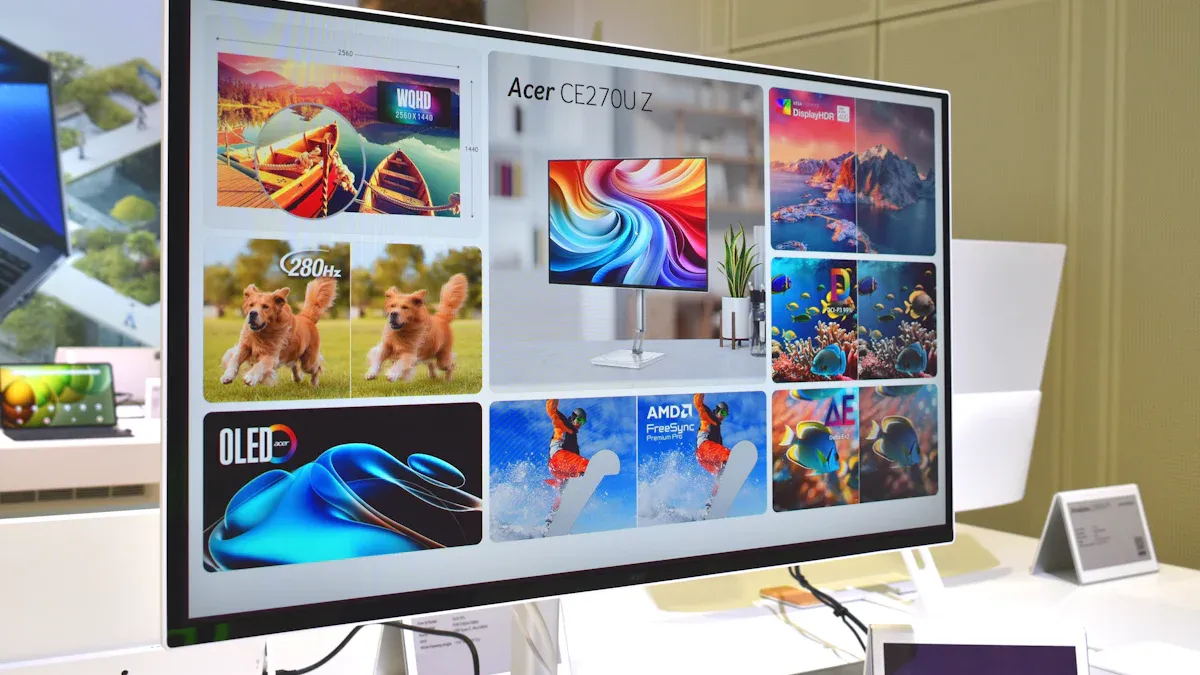
Modern lcd displays have great technical features. The resolution can be HD or 4K. Higher resolution means pictures look sharper and clearer. Indoor screens are bright at 250-300 cd/m². Some outdoor screens are even brighter, over 400 cd/m². Color accuracy is better now with bigger color gamuts. These include sRGB, AdobeRGB, and DCI-P3. You see more real colors on the screen.
Specification | Details |
|---|---|
Resolution | Ranges from HD (1280×720) to 4K (3840×2160), with higher resolutions providing more detail. |
Brightness | Measured in cd/m²; standard for indoor is 250-300, while outdoor may require 400 or more. |
Color Gamut | Includes sRGB, AdobeRGB, and DCI-P3; wider gamuts allow for more accurate color reproduction. |
Some of the biggest lcd tv panels you can buy are the 98-inch Samsung QN90A and the 100-inch Sony Bravia XR. These TVs have 4K resolution and Mini-LED backlighting. They also have smart features. These TVs are very big for homes. The 130-inch display at CES 2026 is even larger and uses newer technology.
Design and Innovations
Modern lcd panels are special because of their design and new ideas. They save energy and are very thin. The picture quality is also very good. These panels last a long time and work in many places, like homes and cars.
Design Feature | Contribution to Performance and Appeal |
|---|---|
Lower operational costs due to reduced power consumption. | |
Slim Profile | Enables sleek, modern device designs that attract consumers. |
Excellent Picture Quality | Provides wide viewing angles and enhanced color accuracy. |
Durability | Suitable for demanding environments, reducing maintenance costs. |
Versatility | Applicable across various sectors, enhancing user experience. |
At CES 2026, you saw new things like QDEF films for better color. QD-on-Glass makes screens super thin. Pillar-to-pillar displays are now in cars. Some panels have privacy modes. Some can turn clear or slide open. For gaming, a 27-inch QHD Oxide TFT LCD has a 610Hz refresh rate and 1ms response time. This is the best for fast games.
Note: Many new TVs mix art and technology. Some TVs show artwork when you are not watching shows. This turns your TV into home decor.
Construction and Engineering
Manufacturing Process
You might wonder how companies make big LCD panels. The process uses many steps to help each display work well and last long. Here is how these giant screens are made:
Glass Substrate Cleaning: Workers wash the glass with chemicals and sound waves. This removes dust and dirt.
Thin Film Deposition: Machines put thin layers of special materials on the glass. They use sputtering or chemical vapor.
Photolithography: A coating goes on the glass. UV light makes patterns for circuits.
Etching and Stripping: Extra material is taken away. Only the needed patterns stay.
Polyimide Printing: A thin polyimide layer is printed. This helps control the liquid crystals.
Rubbing: A soft cloth makes tiny lines. This helps liquid crystals line up right.
Spacer Spread and Sealant Patterning: Small spacers keep glass layers apart. Workers add sealant to hold everything together.
Liquid Crystal Injection: Liquid crystal is put between glass layers in a vacuum.
Scribing and Breaking: The big glass sheet is cut into smaller panels.
Polarizer Lamination: Polarizing films are stuck to both sides of the panel.
COG/FOG Bonding: Driver chips and flexible circuits are attached to the glass.
Integration and AOI: The display is put together and checked for quality.
Tip: Every step must be done right. Even a tiny mistake can cause dead pixels or color problems.
Industry Collaboration
You see teamwork from top companies with the largest LCD displays. Samsung and LG Display lead the industry. They use their best engineers and newest machines to make these panels.
Making large LCDs is hard and brings many challenges:
Environmental Stress: Displays must handle heat, cold, and sunlight. Companies use UV coatings and strong seals.
Mechanical Durability: Screens can break if hit. Engineers make tough frames and covers.
Electrical Failures: Power surges can hurt parts. Makers add special circuits to protect the display.
Manufacturing Defects: Sometimes, pixels do not work. Teams use strict tests to find and fix these problems.
Wear and Tear: Screens get old over time. Companies pick materials that last longer and keep working well.
You get a great LCD display because of teamwork and problem-solving. The result is a big LCD display that looks good and works for years.
LCD vs Largest LED Display in the World
MSG Sphere and LED Exosphere
You might have seen the MSG Sphere in Las Vegas. This building uses the largest led display in the world. The Exosphere wraps around the entire sphere and covers more than 580,000 square feet. Each part of the surface lights up with millions of LEDs. You can see bright images, videos, and animations from far away. The display stays clear even in sunlight or at night. The MSG Sphere shows how LED technology can create huge, eye-catching displays for public events, concerts, and advertising.
The largest lcd display, like the 130-inch Samsung TV at CES 2026, looks impressive in your home or office. It gives you sharp images and vibrant colors. However, it cannot match the size or outdoor brightness of the MSG Sphere. The largest led display in the world can handle weather, sunlight, and large crowds. You get a different experience with each type of display.
LCD and LED: Key Differences
You may wonder why the largest led display in the world is used for public spaces, while lcd screens are common in TVs. The answer comes from how each technology works.
Feature | LED Displays (e.g., MSG Sphere) | LCD Displays (e.g., 130-inch TV) |
|---|---|---|
Light Source | Fluorescent lamps or backlights | |
Brightness | Very high, great for outdoors | Softer, best for indoor use |
Energy Use | More efficient | Higher, due to full backlighting |
LED displays create their own light with tiny diodes.
LCD screens need a separate backlight.
LEDs give you brighter images and use less energy.
You see LED displays on stadiums, billboards, and the MSG Sphere because they stay bright in any light. They can also cover huge areas. LCD panels work best for TVs because they cost less and offer great picture quality for smaller spaces. New features like Mini-LED backlighting and 8K resolution make LCD TVs even better for your home.
Note: The largest led display in the world stands out in public places, while lcd technology shines in personal devices like your TV.
Impact and Future Trends
Influence on Display Industry
The display industry is changing quickly in 2026. Large LCD and LED displays bring new ideas to cities, businesses, and homes. Screens now have higher resolution and better color accuracy. They are also brighter and look more amazing. LED screens use less energy and help the planet. Many companies use parts that can be recycled and some use solar power. Interactive content gets more attention and makes people want to join in. Cities become lively places with real-time info and fun entertainment.
Description | |
|---|---|
Technological advancements | Higher resolution, improved color accuracy, and better brightness make displays more effective. |
Sustainability | LED screens use less energy and include recyclable or solar-powered parts. |
Consumer engagement | Dynamic content attracts users and encourages interaction. |
Urbanization | Weather-resistant LED displays deliver clear visuals to large audiences in busy cities. |
Stores, offices, and schools use large LCD displays to share messages and teach. The biggest lcd display at CES gives ideas for new tv designs. Companies work on products that are good for the environment and save energy. Rules push makers to use materials that are safe for nature.
Future of Large LCD Panels
You will see cool trends for big LCD and LED displays. Flexible LED screens and better liquid crystal options are getting popular. New screens are super thin, brighter, and can be changed to fit needs. The market for big LCD displays is growing fast. People want better pictures for fun and shopping.
Flexible screens and better liquid crystal options are popular.
Super thin and brighter screens are seen more often.
Better resolution and energy saving help the market grow.
Eco-friendly ways to make and recycle displays are normal.
Smart features are added to displays for a better experience.
Mini-LED backlighting makes screens look sharper and brighter. You see bigger screens and higher resolutions like 4K and 8K in the largest LCD TVs you can buy. Makers lower costs and use displays in factories and cars. Saving energy and recycling are important for the future.
Tip: You can expect displays to be smarter, greener, and more exciting. The industry will keep changing as new ideas come out.
You can see the largest LCD display in 2026 is a big change. LCD and LED displays compete, so companies make better screens. They work to improve picture quality, save energy, and make screens last longer. LED screens are bright outside. LCDs show more details and look nice in your home. Big screens change how you watch shows, share news, and talk to friends.
Segment Type | Description |
|---|---|
Advertising | Displays help brands connect with people in public places. |
Communication | Screens let you share ideas and learn at school or work. |
Immersive Experiences | Interactive screens make entertainment more fun and interesting. |
In the future, you will see displays that are smarter, use less energy, and let you do more things.
The Largest LCD TVs Available for Purchase
By 2026, the TV market has entered an era of "100 inches and beyond". Major brands are launching giant screens ranging from 100 to 130 inches, making home cinemas more accessible than ever. The race is led by Samsung, TCL, LG, and Hisense, competing not only on size but also on backlight technology (e.g., Mini-LED vs. Micro RGB) to deliver极致 picture quality on ultra‑large screens.
Below are the flagship models available this year, with core specifications and reference prices to give you a clear picture of the current large‑screen TV landscape.
📺 2026 Flagship Ultra‑Large LCD TVs – Overview
Brand / Series | Size (inches) | Core Display Technology | Peak Brightness / Colour Gamut | Resolution / Refresh Rate | Reference Price (USD) |
|---|---|---|---|---|---|
Samsung R95H | 130 | Micro RGB LCD | 4,000+ nits / 100% BT.2020 | 4K | Not yet announced |
Samsung Micro RGB | 115 | Micro RGB LCD | – | – | $30,000 |
Samsung Neo QLED QN990H | 98 | 8K Mini‑LED | – | 8K 120Hz | ~$11,400 (85″ model) |
Samsung The Frame | 98 | 4K QLED | – | 4K 144Hz | To be announced |
TCL X11L / RM9L | 115 | SQD‑MiniLED / RGB Mini‑LED | 10,000 nits / 100% BT.2020 | 4K 144Hz (up to 288Hz) | To be announced |
TCL X11L | 98 | SQD‑Mini LED | 10,000 nits | 4K | To be announced |
LG QNED90B | 115 | Mini‑LED | – | 4K 165Hz | To be announced |
Hisense UR9 | 100 | RGB Mini‑LED | – | 4K | $2,999.99 (after discount) |
Hisense U6/U7 Series | 100 | Mini‑LED | – | 4K | $1,897.99 – $2,499.99 |
Notes:
Samsung’s Micro RGB technology uses red, green, and blue micro‑LEDs as the backlight source, achieving 100% BT.2020 colour gamut for stunning colour accuracy.
TCL demonstrated the X11L prototype at CES 2026 with a peak brightness of 10,000 nits – one of the highest known values, promising a new level of HDR performance.
Hisense’s UR9 TV features advanced RGB Mini‑LED technology that maintains colour accuracy under high ambient brightness. The 100‑inch model has been available at a discounted price of $3,000.
💎 Summary & Buying Advice
Today, 100‑inch and larger TVs are becoming mainstream choices. Beyond sheer size, technology is the key differentiator in price and performance. Samsung’s Micro RGB series, TCL’s QD‑Mini LED series, and Hisense’s RGB Mini‑LED series all represent the pinnacle of their respective brands.
If you are considering purchasing an ultra‑large TV, focus on top brands such as Samsung, TCL, LG, and Hisense. At the same time, evaluate important parameters: size, budget, backlight technology (e.g., Mini‑LED, Micro RGB), and peak brightness.
FAQ
What makes the largest LCD display in 2026 special?
You see a 130-inch LCD TV at CES 2026. This display uses advanced Mini-LED backlighting and Micro RGB technology. The screen shows bright colors and sharp images. You experience movie-like quality at home.
Can you buy the largest LCD TVs?
You can buy large LCD TVs like the 98-inch Samsung QN90A or the 100-inch Sony Bravia XR. These models offer high resolution and smart features. The 130-inch display at CES is a showcase, not for sale yet.
How do LCD and LED displays differ?
You see LCD screens use a backlight to show images. LED displays use tiny diodes that make their own light. LED screens work best outdoors. LCD TVs give you clear pictures indoors.
Where do you find the top 10 largest led displays?
You find the top 10 largest led displays in stadiums, city centers, and entertainment venues. These displays show bright images and videos to large crowds. They help with advertising and public events.
Why do companies use LCD panels for TVs?
You get LCD panels in TVs because they cost less and show detailed images. LCD screens work well in homes and offices. LED displays are better for big outdoor spaces.
See Also
Key LCD Display Innovations to Watch for in 2026
Top LCD Kiosks Perfect for Retail Spaces in 2026
How Circular LCD Displays Are Revolutionizing Signage in 2025
