Digital Signage Benefits and Key Statistics for 2026
Shenzhen TopAdkiosk Display Technology Co., Ltd.
Add.: 2F, Bldg 10, Changfeng Industrial Park, Dongkeng, Fenghuang, Guangming, Shenzhen, China 518132
Mobile/WHATSAPP: 86-138 25769658
Email: marketing@topadkiosk.com topadkiosk@gmail.com
Skype: pghenry1
Wechat: adkioskhenry
English Web.: http://www.topadkiosk.com/
https://www.topkioskdisplay.com/
http://www.ad-kiosk.com/
https://www.toplcddisplay.com/
http://www.multitouchdigitalsignage.com/
https://www.youtube.com/channel/UCYVYNJHxLVEcQD8fuUxXNTA/videos?view_as=subscriber
https://www.facebook.com/TOPADKIOSKSHENZHEN/?ref=bookmarks

Digital signage benefits you by enabling effective communication with people in impactful ways in 2026. Research shows that people remember messages 83% of the time, and retail sales can increase by 32%. The table below illustrates how digital signage works better than traditional signs:
Statistic | Value |
|---|---|
Average sales increase (retail) | 32% |
Views compared to static signs | 400% more |
Message recall rate | 83% |
Customers who entered stores due to signage | 80% |
You can leverage the digital signage benefits to enhance worker performance. It captures attention more effectively and contributes to higher customer satisfaction. New statistics demonstrate how these advantages can significantly impact your business or organization.
Key Takeaways
Digital signage can help sales go up by 32%. It also helps customers pay more attention.
For every dollar spent on digital signage, businesses get back $4 to $6. This makes it a smart way to save money.
Digital signage helps people talk and share ideas better. It can make workers 25% more productive. Customers are also happier.
Using digital signage means less waste and less energy used. This is better for the environment and helps businesses too.
Digital Signage Market Growth and ROI
Digital Signage Statistics for 2026
The digital signage market is growing quickly. Experts think it will reach $33.56 billion in 2026. This means more businesses are using digital signage to help them grow. You can see digital signage displays in stores and hospitals. New statistics show many people are using digital signage and getting good results.
Metric | Value |
|---|---|
Market Size | $28.83B in 2024 → $45.94B by 2030 → $57.72B by 2035 |
ROI | $4–6 returned per $1 spent on operational signage |
Healthcare Adoption | 70% of US hospitals run digital signage |
DOOH Market Size | $22.51B in 2026 → $56.1B by 2034 |
Digital Signage in Retail | 60%+ use digital displays |
Brand Recall Rate | 83% (vs. ~40% for print) |
Dwell Time Increase | +30% with motion graphics |
These numbers show digital signage helps many industries. You can use digital signage to make people remember your brand. It also helps you connect with customers and grow your business. More companies are choosing digital signage, so its future looks good.
Digital Signage ROI and Cost Savings
You may wonder how digital signage ROI compares to old methods. Digital signage gives you clear returns and saves money. For every dollar spent, you get back $4 to $6. This happens because communication is better, there is less waste, and updates are easier.
Aspect | Digital Signage | Traditional Methods |
|---|---|---|
Upfront Investment | Higher initial costs for hardware, software, and installation | Lower initial costs for printed materials |
Long-Term Savings | Substantial savings over time due to reduced operational costs | Recurring costs for printing and distribution |
Operational Efficiency | Remote management and automated updates reduce ongoing costs | Manual updates and physical distribution required |
Waste Reduction | Lower material costs and less waste generation | High material costs and waste from printing |
Scalability and Flexibility | Easy to expand and update content dynamically | Difficult to scale and update without new prints |
Digital signage helps you save money as time goes on. You can change messages fast and easily. These benefits make digital signage a smart way to help your business grow and work better.
Digital Signage Benefits by Industry
Retail: Increase Sales and Engagement
Digital signage helps stores get more customers. It can make people buy more things. When stores use digital signage, shoppers stay longer. This means they might buy more. Interactive screens help people find products fast. Digital signage can raise sales by up to 33%. About 80% of shoppers go into a store after seeing digital signage. Customer happiness goes up by over 45% with digital signage. Stores have seen sales go up by almost 30%. Ad recall rates can go up by over 50%. Seventy percent of customers say digital signage changed what they bought. Sixty-four percent of businesses see better brand engagement. Over half of users notice better customer service. Forty percent of shoppers think digital displays make shopping easier by giving good info at checkout. These facts show digital signage can help you sell more and make customers happier.
Corporate: Internal Communication and Productivity
Digital signage can change how your office works. It helps you share news and updates fast. Employees feel more involved when they see important info. Digital signage makes it easy to send alerts and real-time updates. Companies that talk well with workers have higher engagement. Digital signage can make workers 25% more productive. Workers who do not feel involved are more likely to quit. Employees who feel valued work harder. You can use digital signage to share company news and safety alerts. Visual messages get almost twice as many views as text. Fast updates help teams react quickly. Digital signage supports good communication and helps workers do better.
Education: Campus Communication and Learning
Schools and colleges use digital signage to share news. It helps students know about events and emergencies. Most students like getting info from digital channels. Digital signage helps students learn and remember more. Almost all students prefer digital channels for news. Digital signage can lower student stress by almost half. Sixty-five percent of students remember more with visuals. Most schools think digital signage is key for the future. Technology like digital signage makes learning better. Students remember digital signage content very well. Digital signage gets four times more views than regular signs. Students remember up to 41% more with digital signage. You can help students feel confident and do better in school with good content.
Healthcare: Patient Experience and Efficiency
Digital signage helps patients in hospitals and clinics. It makes it easier for people to find their way. Patients feel less worried when they see helpful info. Digital signage gives updates and keeps everyone informed. It is almost 50% faster to set up than old systems. Wait times feel shorter by over a third. Patient happiness scores go up by over 20%. Staff get fewer questions about directions. Patient anxiety drops during busy times. People feel better about wait times. Missed appointments can go down by up to 30%. More people book services when they see them on screens. Mayo Clinic saw patient happiness go up by 28% with digital signage. Emergency rooms saw less patient worry during busy times. Digital signage helps everyone know what is happening and makes visits better.
Hospitality: Guest Engagement and Revenue
Hotels and restaurants use digital signage to help guests. It gives personal tips and shows real-time info. Digital signage can tell guests about events and services. It helps staff by answering common questions. Seventy percent of hotel guests like digital signage. The digital menu board market is worth billions of dollars. It will be worth even more in the future. Thirty percent of diners say digital menus affect what they order. Digital menu boards can raise sales by 5%. Digital signage helps guests find their way and learn about activities. Hotels with digital signage get happier guests and more repeat visits. It helps show off your brand and makes stays special.
Digital Signage vs. Traditional Signage
Engagement and Message Recall
You want your message to be noticed and remembered. Digital signage does this better than traditional signs. Studies show digital signage gets attention 70% more than static ads. People remember messages from digital screens 83% of the time. Static print ads only reach a 40% recall rate. This means your audience remembers what you show on a digital display more.
Type of Signage | Recall Rate | Engagement Level |
|---|---|---|
Digital Signage | 83% | Higher |
Static Print Ads | 40% | Lower |
Digital signage makes visuals more interesting.
It helps people spend more time with your content.
Moving images and dynamic content help people remember better.
When you use digital signage, your message reaches more people. It stays in their minds longer. This is a big benefit for any business or group.
Performance and Efficiency
You need tools that work quickly and save money. Digital signage gives real-time updates and lets you change content fast. Traditional signs need reprinting and manual changes. This takes more time and costs more money. Digital signage also collects data about what people watch. You can use this data to make your content better and improve results.
Feature | Digital Signage | Traditional Signage |
|---|---|---|
Content Type | Dynamic, interactive multimedia | Static text and images |
Update Frequency | Real-time updates | Requires re-printing |
Audience Targeting | Tailored messages | General messaging |
Data Analytics | Collects viewer data | No data collection |
Environmental Impact | Less waste, energy efficient | More waste, uses chemicals |
Tip: Digital signage cuts down on paper waste and printing costs. You help the environment and save money at the same time.
Digital signage lets you control displays from anywhere. You can update messages for different groups or times. This flexibility makes your communication better and improves performance. You get good results with less work. Digital signage is a smart choice for modern businesses.
Additional Digital Signage Benefits
Operational Efficiency
Digital signage helps you work better and faster. Many groups see big improvements after using digital displays. Sales can go up by about 32%. Sharing news at work gets easier. This makes workers 25% more productive. Good communication at work means people are four times more likely to care about their jobs. Digital signage lets you share important news fast. It keeps everyone updated and working together.
You can control what shows on screens from anywhere. This makes your work more flexible.
You can change many screens at the same time. This saves time and cuts down on extra work.
You make sure every place shows the same message. This helps people remember your brand.
You can quickly change what is on the screens. This keeps your messages up to date.
Here is how digital signage makes work easier:
Benefit | Description |
|---|---|
Remote accessibility | You can control screens from anywhere. This helps you react fast. |
Efficiency | You can update many screens at once. This saves time and work. |
Scalability | You can handle more screens as your business grows. |
Automatic updates | The screens update by themselves. You do not have to do it by hand. |
Targeted messaging | You can show special messages for different groups or places. |
Real-Time Updates and Sustainability
You get a big benefit with real-time updates. Digital signage lets you send out news right away. You can keep people safe during emergencies or when things change fast. You can change what is on the screens from one place. This makes sure everyone gets the newest information. This helps keep your group safe and organized.
Digital signage is also good for the planet. You use less paper and save energy. New screens use up to 90% less energy than paper signs. Digital screens last longer, so you do not have to replace them often. This helps the earth and saves you money.
Benefit | Digital Signage | Printed Materials |
|---|---|---|
Material Use and Waste | No need for paper or ink | Uses a lot of paper and ink |
Energy Efficiency | Uses more energy | |
Longevity | Lasts longer and needs fewer changes | Needs to be replaced often |
Environmental Impact | Is better for the earth | Hurts the environment |
You can use moving pictures and new content to keep messages interesting. You can set up schedules and let the system work by itself. This means less work for you and more people pay attention. Digital signage is a smart and green way to share news.
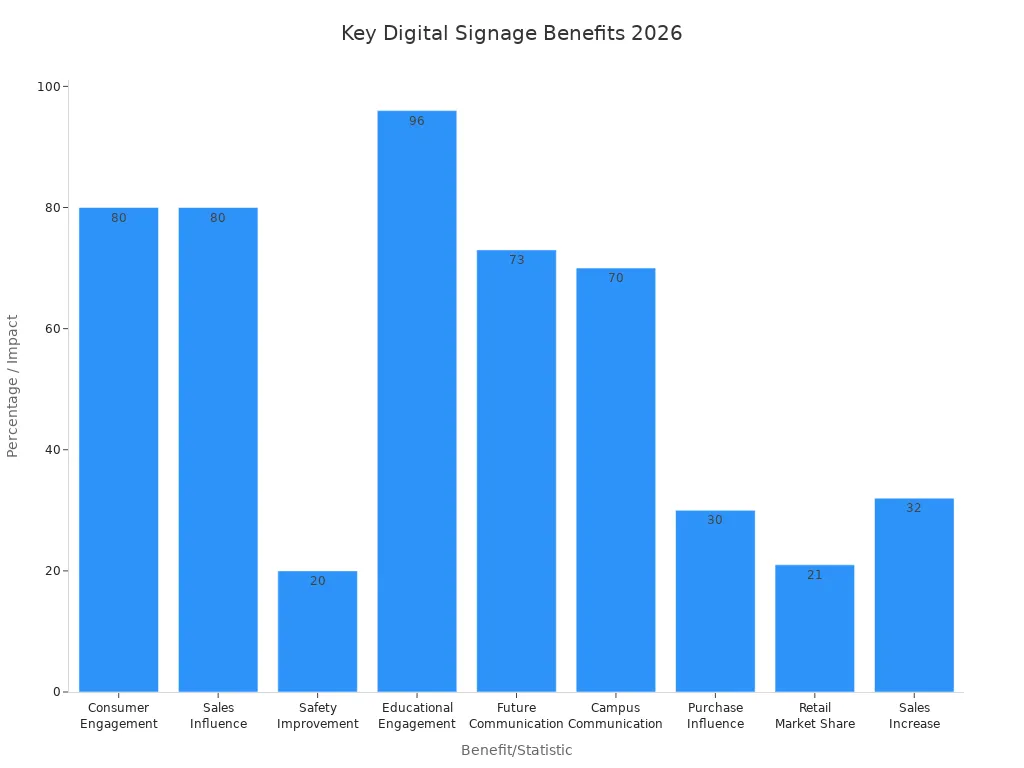
You get clear benefits when you use digital signage. The numbers show it works well in many places. For example, 80% of people go into a store after seeing a digital sign. Stores say their sales go up by 32%. Schools, hospitals, and restaurants also see better results. They have more people paying attention and talking with them. The table below shows some important facts:
Benefit/Statistic | Description |
|---|---|
Consumer Engagement | 80% of consumers enter stores after seeing digital signage |
Sales Influence | 80% more likely to buy with digital signage present |
Educational Engagement | 96% of students say video content helps them learn |
Hospitality Growth | Digital menu boards will reach $4–5.4B by 2033 |
You will see even more good things as new tools like AI and cloud management grow. Interactive displays will also help. Digital signage is a smart choice for 2026.
1. Captures Attention & Boosts Engagement
Digital signage is visually dynamic – motion, video, and bright colors naturally draw the eye far more effectively than static posters or printed signs.
Higher recall: Viewers remember moving content up to 5x more than static text.
Longer dwell time: Screens keep people engaged while they wait (elevators, lobbies, checkout lines).
Targeted messaging: Different content for different times of day (e.g., breakfast menu in the morning, happy hour in the evening).
Example: A retail store using digital signage for promotions sees a 31% average uplift in sales for featured products compared to static signs.
2. Real‑Time Updates & Instant Communication
With traditional print, changing a price or a message means ordering, printing, and shipping new materials – days or weeks. Digital signage updates in seconds.
Urgent alerts: Weather warnings, safety instructions, or building lockdowns can be pushed instantly to every screen.
Live data integration: Display real‑time KPIs, stock prices, social media feeds, or wait times.
Centralized control: Update hundreds of screens from one dashboard, regardless of location.
Example: A restaurant chain can change menu prices across all 50 locations in under 5 minutes, not 5 weeks.
3. Cost Savings Over Time
While there’s an upfront investment, digital signage nearly always pays for itself when compared to recurring print costs.
Cost Type | Printed Signs | Digital Signage |
|---|---|---|
Per‑sign production | 5–5–50 each | $0 (after content is created) |
Recurring design/print | Every campaign | One‑time design, reusable |
Labor to distribute | Hours per location | Seconds (remote upload) |
Waste due to errors | High (reprint) | None (edit and republish) |
Typical ROI: Many organizations recoup their investment within 6–12 months simply by eliminating print and distribution costs.
4. Enhanced Customer Experience
Digital signage can inform, entertain, and guide – all of which improve how people feel about your brand.
Wayfinding: Interactive maps help visitors navigate hospitals, airports, or malls.
Queue management: Show estimated wait times and entertain waiting customers with tailored content.
Self‑service: Touchscreen kiosks let customers check in, place orders, or find information without staff assistance.
Example: A hospital using digital wayfinding reduces missed appointments by 20% and lowers front‑desk traffic.
5. Improves Internal Communications (Employee Engagement)
For deskless workers (retail, healthcare, manufacturing, logistics) who rarely sit at a computer, digital signage is often the only reliable channel.
Break‑room screens: Share safety reminders, shift changes, performance metrics, and recognition.
Real‑time dashboards: Let warehouse or sales teams see live KPIs (e.g., units picked per hour, daily sales vs. target).
Culture building: Celebrate birthdays, work anniversaries, and employee of the month – visible to everyone.
Stat: Companies using digital signage for internal comms report up to 80% higher message recall compared to email.
6. Increases Revenue & Drives Sales
Digital signage is a direct sales tool when placed at the point of decision.
Upselling and cross‑selling: A fast‑food digital menu board can highlight add‑ons (e.g., “Make it a meal for $2 more”).
Impulse purchases: Eye‑calling promotional screens near checkout lines drive last‑minute buys.
Dynamic pricing: Change prices instantly based on demand, time of day, or inventory levels.
Example: Convenience stores using digital signage at the point of sale see an average 15–30% lift in impulse item sales.
7. Measurable & Data‑Driven
Unlike a printed poster, digital signage can be measured.
Content performance: Which messages get the most views? (some platforms offer audience analytics via cameras or sensor data)
A/B testing: Run two versions of an ad on different screens to see which performs better.
Integration with business data: Pull sales figures, foot traffic counts, or social media engagement directly into your signage analytics.
8. Environmentally Friendly
Digital signage eliminates paper, vinyl, and plastic waste from traditional printing.
No disposal cost: Update content without throwing away old signs.
Lower carbon footprint: No shipping of physical materials.
Supports green initiatives: Organizations can publicly document reduced waste from switching to digital.
Example: A university switching its campus notice boards to digital signage saves over 10,000 sheets of paper and 200 square feet of vinyl per year.
9. Scalability & Consistency
Managing one screen or one thousand uses the same software.
Brand consistency: Every location shows the same approved messaging, colors, and logos.
Local flexibility: Different screens can show different content – corporate headquarters may see strategic KPIs while a factory floor sees safety stats.
Easy rollout: Add new screens without redesigning your entire communication workflow.
10. 24/7 Availability
Digital signage never sleeps. It can display information around the clock – crucial for airports, hospitals, public transport, and emergency services.
After‑hours mode: Even with no staff present, screens can show wayfinding, emergency contact numbers, or promotional loops.
Reliability: Commercial‑grade displays are designed for 16–24/7 operation with proper cooling and anti‑burn‑in features.
Quick Summary Table
Benefit | Key Takeaway |
|---|---|
Engagement | Motion and color grab attention better than static signs. |
Real‑time updates | Change content in seconds, not days. |
Cost savings | Eliminate recurring print and distribution costs. |
Customer experience | Inform, entertain, and guide visitors. |
Internal comms | Reach deskless workers effectively. |
Revenue | Drive upsells and impulse purchases. |
Measurable | Track what works and improve. |
Eco‑friendly | Reduce paper and plastic waste. |
Scalable | One dashboard for 1 or 1,000 screens. |
24/7 availability | Always‑on information when needed. |
Bottom Line
Digital signage isn't just a nicer way to display information – it’s a strategic tool that saves money, increases engagement, drives revenue, and improves communication across almost any industry. Whether you run a coffee shop, a hospital, or a global enterprise, the benefits are measurable and the ROI is clear.
FAQ
What is digital signage?
Digital signage shows info, ads, or news on screens. You see it in stores, schools, hospitals, and offices. It helps you share messages fast and keeps people up to date.
How does digital signage help my business?
You can sell more, talk to people better, and make your brand special. Stores can get up to 32% more sales. You also save money because you do not need to print new signs.
Is digital signage easy to update?
Yes. You can change what is on all screens from one computer. This saves time and lets you send news or alerts right away.
Does digital signage help the environment?
You use less paper and ink with digital signage. New screens use less energy. This means you make less waste and help the earth.
Where can I use digital signage?
You can use digital signage in lots of places:
Retail stores
Offices
Schools
Hospitals
Hotels
It works well anywhere you want to share info or get people interested.
See Also
Why Digital Signage Screens Are Key To Business Success In 2026
Latest Innovations In Digital Signage Technology For The Year 2026
Emerging Digital Signage Trends Influencing 2026 Today
